

Sophia Bennett
Crypto Analyst
There is a number that matters psychologically more than almost any other in Bitcoin markets. That number is $70,000. On Tuesday, it gave way, and the data beneath the price suggests the selling may not be finished.
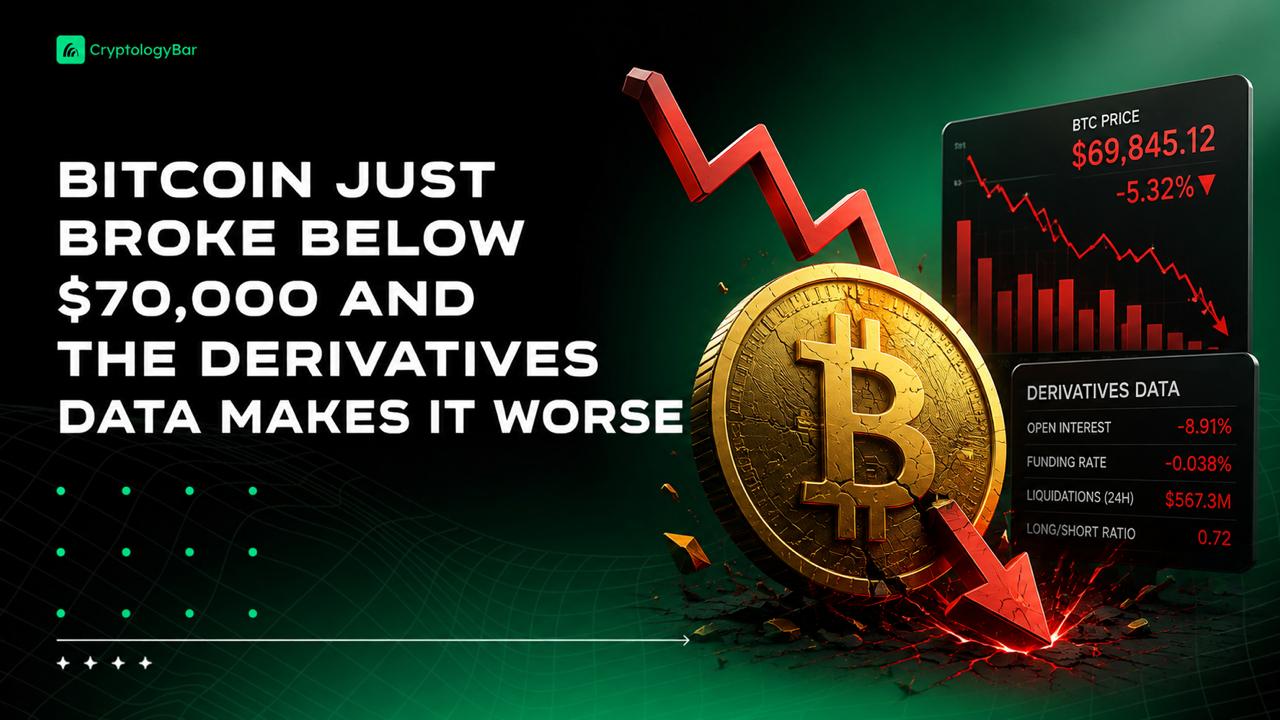
Bitcoin slipped below the psychologically important $70,000 level on Tuesday, trading around $69,300, as derivatives positioning reached some of the most elevated levels of the current cycle.
For a market that had already spent weeks struggling to hold $77,000, this is a significant deterioration, and the signals pointing to further downside are coming from multiple directions at once.
Open Interest Is at One of Its Highest Levels Ever
When open interest climbs as prices fall, that is a warning sign. It means leverage is building in a declining market, a combination that historically ends with a sharp liquidation flush.
Open interest across bitcoin futures markets has climbed to approximately 773,000 BTC, a level last seen only a handful of times on record, according to Coinglass data. Previous peaks have occurred during local market tops. The current positioning suggests leveraged traders are betting on a quick price rebound rather than trimming risk.
Those traders betting on a rebound are now sitting in positions that are bleeding, and the longer Bitcoin stays below $70,000, the more pressure builds to close them.
Funding Rates Are Still Positive, and That Is the Problem
In a falling market, you would normally expect funding rates to turn negative as traders flip to shorting. That has not happened yet, and that makes the setup more dangerous, not less.
That growing leverage is also reflected in perpetual futures funding rates, which have risen to roughly 10% annualised, according to Coinglass data. Positive funding means long traders are paying shorts to maintain positions. As bitcoin continues to fall, long leverage liquidations occur, sending the price lower.
A 10% annualised funding rate combined with a falling spot price is one of the most combustible combinations in derivatives markets. The longs are paying to hold positions that are losing money in real time. At some point, those positions close, and the resulting liquidation cascade sends prices lower before a floor is found.
The Coinbase Premium Is Flashing Institutional Withdrawal
The funding rate story is concerning on its own. The Coinbase Premium Index makes it worse.
Broader sentiment remains apathetic. The Crypto Fear and Greed Index continues to signal fear, while the Coinbase Premium Index remains deeply negative at around -100. The metric measures the price difference between bitcoin on Coinbase and offshore exchanges, with a negative reading often indicating weaker demand from US institutional and spot investors, a trend clearly reflected in the continuing outflows from the US‑based spot BTC ETFs.
A reading of -100 on the Coinbase Premium Index is about as clear a signal as this metric produces. US institutional buyers, the cohort that drove Bitcoin from $60,000 to $126,000 through 2025, have stepped back from the market.
The Disconnect Nobody Can Explain
What makes the current situation genuinely puzzling is the broader market context.
The divergence between leveraged bullish positioning and deteriorating spot demand comes as bitcoin remains largely uncorrelated to broader risk assets, with AI and software stocks continuing to push to fresh highs.
AI stocks are hitting records. The S&P 500 just posted a nine‑week winning streak. Risk appetite in traditional markets is strong. And yet Bitcoin is below $70,000 with record open interest, elevated funding rates, and deeply negative institutional demand signals.
The divergence does not resolve itself automatically. Either traditional markets catch down to Bitcoin, or Bitcoin eventually finds a catalyst to catch up. Right now the data suggests the path of least resistance is lower, and the derivatives market is the clearest evidence of that.