

Sophia Bennett
Crypto Analyst
Someone just made a decision that can't be undone, and it cost them more than money.
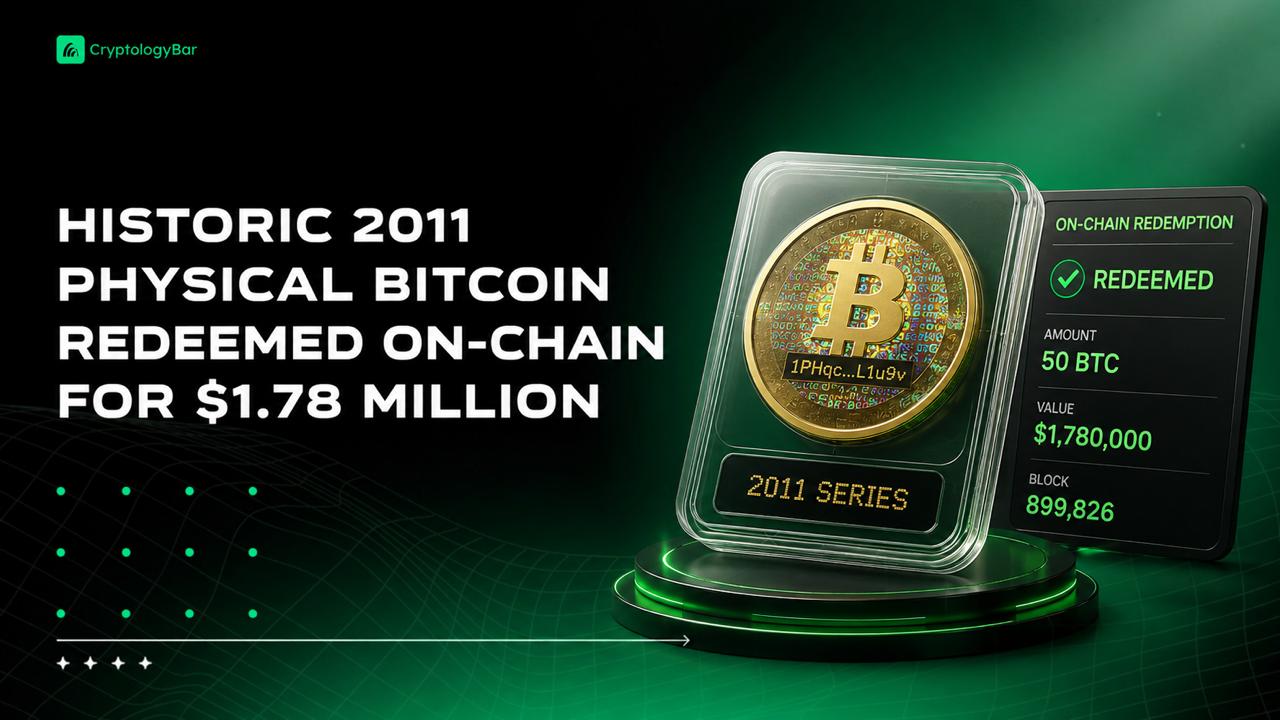
A physical bitcoin from the legendary 2011‑2013 Casascius mint had its hologram seal removed on Wednesday and the 25 BTC stored inside, worth $1.78 million, transferred to a new wallet.
The moment it was opened, the coin's status as a rare collectible was gone forever. What remained was just 25 Bitcoin, valuable, but no longer extraordinary in the way a sealed Casascius coin is.
What Is a Casascius Coin?
For anyone unfamiliar with early Bitcoin history, these coins are genuinely fascinating objects.
Casascius coins were physical tokens created by software engineer Mike Caldwell in denominations of 0.5, 1, 5, 10, 25, 100 and even 1,000 BTC. Each coin had its receiving bitcoin address printed on the outside, with the matching private key concealed under a tamper‑evident hologram on the back.
They were, in the simplest terms, physical objects that held real Bitcoin. An elegant solution to a digital‑age problem, how do you physically hand someone Bitcoin?
Holders could spend the bitcoin at any time by peeling the hologram and importing the private key into a wallet, a one‑way move that destroyed the coin's collectible status.
Why the Project Came to an End
Caldwell's Casascius experiment didn't end by choice. Caldwell halted production in late 2013 after the U.S. Financial Crimes Enforcement Network advised him he was operating as a money transmitter without a license.
That forced shutdown is precisely what makes intact Casascius coins so rare today. No more were ever minted after 2013, meaning every surviving sealed coin is a fixed piece of an already tiny supply.
The Collectible Value Is the Real Story
Here's what makes Wednesday's redemption genuinely significant beyond the Bitcoin value involved.
Intact‑hologram Casascius coins occupy an unusual category in collectibles markets. Each piece holds real bitcoin at face value and commands a numismatic premium for the physical artifact when sold intact in collector markets.
In other words, a sealed 25 BTC Casascius coin is worth more than 25 Bitcoin, because the physical object itself carries additional value to collectors. By peeling the hologram, the owner converted a premium collectible into standard Bitcoin.
Peeling a Casascius is a one‑way trade with real economic stakes. Intact Series 1 large‑denomination coins typically command a premium over their face bitcoin value, meaning Wednesday's redemption converted what could have been a higher‑priced collectible back into pure bitcoin.
The Rarest of All
Some Casascius coins are so scarce they've reached almost mythological status.
Caldwell minted fewer than 20 of the 1,000‑BTC denomination pieces, most of which are still intact and would each now hold the equivalent of roughly $66 million in bitcoin.
Those coins, still sealed after more than a decade, represent one of the most unusual intersections of physical collectibles and crypto wealth ever created.
Thousands Still Remain Unsealed
Thousands of Casascius coins remain unredeemed across all denominations. The redemption, recorded in Bitcoin block 952,159, arrives during a week of unusual activity from long‑dormant Bitcoin holdings, including a 2011‑era wallet that moved 35 BTC after 15 years of dormancy.
Something is clearly stirring at the quiet end of Bitcoin's oldest wallets this week. Whether it's coincidence or a signal of something broader, nobody quite knows yet.