

Payal Singh
Crypto Analyst
TL;DR
A DEX aggregator checks many decentralized exchanges at once and routes your trade through whichever combination returns the most tokens, usually beating a manual swap on one venue. The savings are small on tiny trades and meaningful on larger or less liquid ones, where slippage and routing really start to matter.
Key takeaways
- An aggregator scans many DEXs and routes for the best total price automatically.
- Liquidity is scattered, so one exchange is rarely the cheapest on its own.
- Savings are biggest on large trades, thin pairs, and cross-chain moves.
- The tool optimizes price, but you still verify what you sign.
Here's something that quietly annoyed me for years before I did anything about it. You swap the same token, for the same amount, through two different decentralized exchanges, and the price you get back can differ by a noticeable margin. Not loose change. On a larger trade, enough to sting.
The reason is that a DEX aggregator exists to solve exactly that gap, and most people trading on‑chain still don't use one. So let me walk through what it actually does, when it's worth it, and the part it won't do for you.
What an aggregator actually is
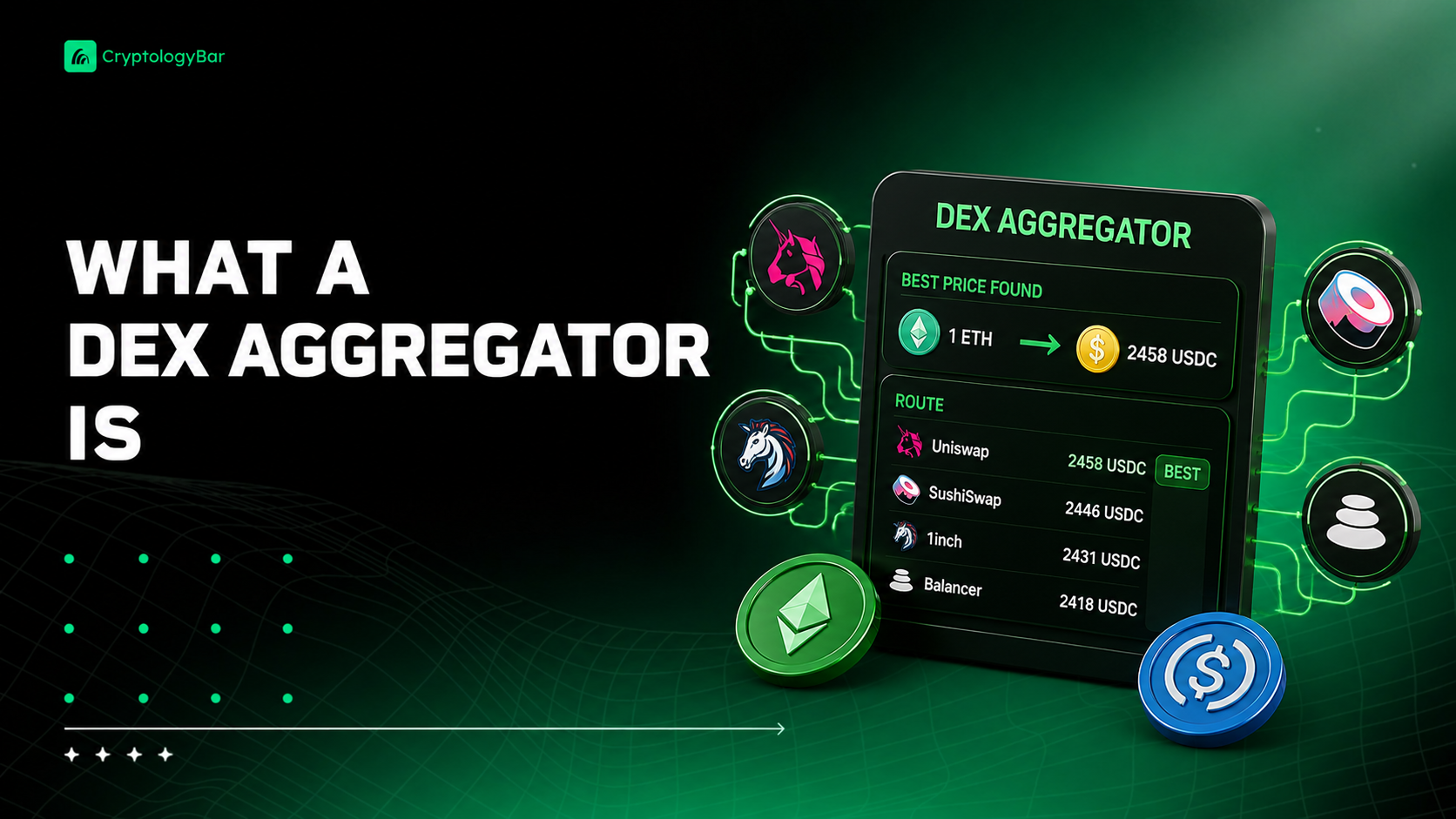
Strip away the jargon and it's simple. An aggregator is a tool that checks dozens of decentralized exchanges at once, then routes your trade through whichever combination gives you the most tokens back. You don't pick the venue yourself. The aggregator picks, and it usually picks better than you would, because it's comparing more options than you ever could by hand in the few seconds before a price moves.
I used to just swap on whatever DEX I already had open. Pure habit. Then I started comparing the quotes I was getting against other routes and realized I'd been quietly leaving money on the table for a long time. Not a fortune on any single trade. But it adds up, and on the bigger swaps it genuinely hurt.
Why a single exchange is rarely the best price
The core problem is that liquidity is scattered. The same token pair might be deep and cheap on one pool and thin and expensive on another, and the prices drift apart all day as people trade against them. Push a large order through one thin pool and slippage, the gap between the quote and what you actually receive, takes a real bite.
An aggregator sidesteps that by splitting a single order across several pools, so each slice fills at a better rate than forcing the whole thing through one. Three pools, one transaction, less damage. It will also route through an intermediate token when that path is cheaper, going from token A to B to C because the direct A‑to‑C hop happens to cost more. You would never sit there calculating that mid‑trade. The software does it before you've finished reading the quote.
When it actually matters
To be fair, it isn't always worth it. On a tiny swap, the price improvement can be smaller than the extra gas you pay for a more complex route, so a simple direct swap wins. The savings show up as the trade grows, on illiquid pairs where pools are shallow, and especially when you're bridging value between chains, where routes and fees vary wildly depending on the path.
That's the exact spot where I've leaned on Blazpay lately. It's an aggregator across the board, swaps, bridges, and even recurring DCA buys, so it hunts for the best rate among everything available rather than locking you into a single route, and the AI layer handles the route comparison so you're not juggling a row of browser tabs. If you want to see the spread between routes for yourself before committing, it's worth a look at defi.blazpay.com.
Where people still get it wrong
The biggest mistake isn't picking the wrong aggregator. It's trusting the tool so completely that you stop checking the basics. An aggregator optimizes for price. It does not do your due diligence for you. So a few habits are still yours to keep.
Read what you're signing. Set a sane slippage tolerance instead of leaving it wide open, which invites bots to sandwich your trade. And on a brand‑new token, double‑check you're routing through real liquidity and not a trap pool designed to look deep until you try to sell. The aggregator will happily find the cheapest route into a bad token. Avoiding the bad token is on you.
The takeaway
For anything beyond pocket‑change swaps, comparing routes is just free money you're otherwise leaving behind, and an aggregator does the comparing automatically. Use one for the price, keep your own judgment for the safety, and you get the best of both. Loyalty to a single DEX out of habit is the quiet, recurring tax most on‑chain traders never notice they're paying.