

Payal Singh
Crypto Analyst
TL;DR
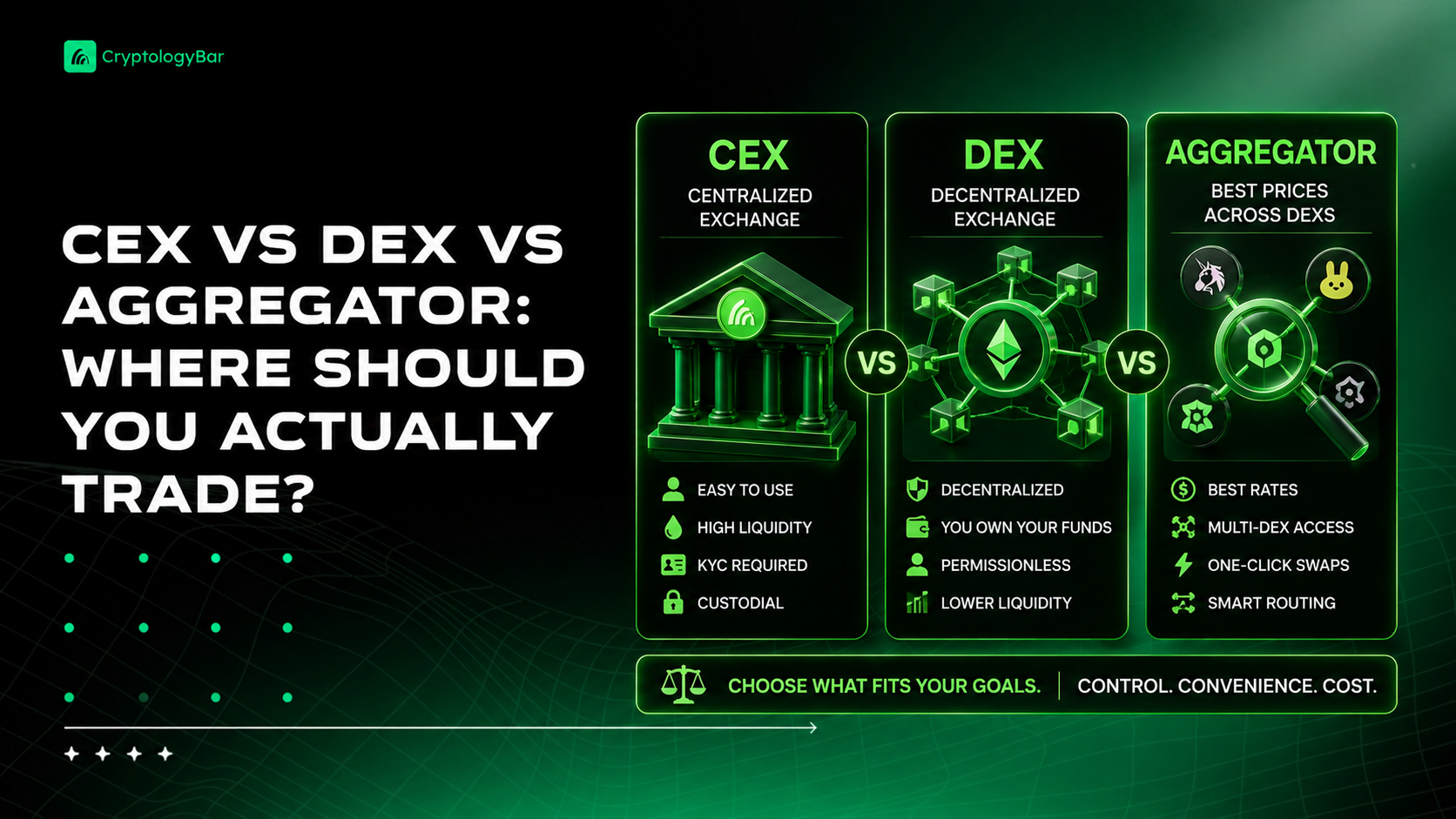
A centralized exchange is the simplest, most liquid place to trade but it holds your funds. A decentralized exchange gives you self-custody and early access, at the cost of picking the venue and wearing the slippage. An aggregator keeps you self-custodial while routing across many DEXs for the best price. Use each for what it's good at.
Key takeaways
- A centralized exchange is easiest and most liquid, but the platform holds your keys.
- A decentralized exchange is self-custody and permissionless, but you pick the pool and eat slippage.
- An aggregator scans many DEXs and splits your order for the best on-chain price.
- Custody is the real dividing line, so match the tool to the trade rather than to habit.
People argue about centralized versus decentralized exchanges like it's a question of identity. It isn't. They're tools for different jobs, and there's a third option, the aggregator, that a lot of newcomers don't even know exists until they've already overpaid a few dozen times. So let me give you the long version, the one that actually helps you decide, instead of the tribal one.
It all starts with the only distinction that genuinely matters: who is actually holding your money?
The question that splits everything: custody
On a centralized exchange, the company holds your crypto. You get an account, a password, maybe a support line, while behind the scenes the platform controls the private keys. On a decentralized exchange or an aggregator, you hold the keys yourself through your own wallet, and the trade happens straight from it. Almost everything else people debate, the fees, the speed, which coins you can even buy, ends up being a downstream consequence of that single fact. It's worth sitting with before anything else, because people forget it right up until the moment it costs them.
The quick comparison
| Type | Custody | Best for | The catch |
|---|---|---|---|
| CEX (Coinbase, Binance, Kraken) | Platform holds funds | Beginners, fiat on‑ramps, deep liquidity, big orders | Not your keys; can freeze, restrict, or fail |
| DEX (Uniswap, Raydium) | You hold funds | Self‑custody, early tokens, permissionless access | You pick one pool and absorb its slippage |
| Aggregator | You hold funds | Best price across many DEXs, larger on‑chain trades | Still sign carefully; new‑token risk remains |
The centralized exchange
For most people a centralized exchange is the first door, and that's the right call more often than the purists admit. You can fund it from a bank or a card, the interface looks like any other finance app, and there's enough liquidity that a normal‑sized order fills instantly at a fair price. Fumble something and there's usually a path back. That cushion counts for a lot when you're starting out.
What it costs you is harder to see than the trading fee. Handing your keys to a company means trusting that company to stay solvent and honest, and while most manage both, the ones that didn't took a lot of people down with them. Anyone who kept their savings on FTX in late 2022 found out, very suddenly, that a balance on a screen and money you actually control are not the same thing. For a small, active balance that's fine. For a stack you plan to hold for years, leaving all of it on an exchange is a bet you don't need to make.
The decentralized exchange
A decentralized exchange works the other way around. You plug in your own wallet and trade straight against pools of liquidity. No company sits in the middle, nothing can be frozen, and you can often buy a token long before it reaches a big‑name platform. If you spend real time on‑chain, that reach and control are most of the appeal.
The cost is that routing the trade well lands on you, and that's quietly where newer traders lose money. Liquidity is scattered. A pair that's deep and cheap on one pool can be shallow and brutal on another, and pushing a sizable order through a shallow one means slippage, the polite word for getting a worse price than the screen quoted a second ago. On top of that you pay the network's gas, which rises and falls with congestion. None of this is hidden, exactly. It just won't tap you on the shoulder to say you chose badly.
The aggregator, which far fewer people know about
This is the piece that deserves more attention than it gets. An aggregator keeps you in your own wallet, like a decentralized exchange, but stops making you pick a single venue. Instead it looks across many at once and assembles the cheapest path it can find, sometimes by splitting one order over a few pools, sometimes by routing through a second token because the direct hop happens to cost more. That kind of fast, repetitive comparison is tedious for a person and trivial for software.
On a tiny swap the savings might not clear the extra gas, so it isn't always worth it. On a larger trade, a thin pair, or a move across chains, the gap between the best and worst route stops being a rounding error in a hurry. That's the reason I've leaned on Blazpay for this lately. It pulls swaps, bridges, and recurring buys into one place and sends each trade down the best route it can find rather than tying you to one provider, with the comparison handled for you instead of across a row of browser tabs. If you'd rather see the difference between routes before committing, it's worth a look at defi.blazpay.com.
A quick scenario to make it concrete
Picture moving a decent chunk of some mid‑sized token. On a centralized exchange you'd likely get a clean fill, but the funds sit with the platform and the token might not even be listed there. On one decentralized exchange you keep control, yet a shallow pool could quietly shave a real percentage off the trade. Run the same order through an aggregator and it gets spread across the deepest routes available, the slippage shrinks, and your keys never leave your hands. One trade, three results, and the spread between them is money that was either in your pocket or not.
So where should you actually trade?
All three, depending on the day. A centralized exchange is the right tool for turning cash into crypto and back, and for a smaller balance you don't mind a third party holding. As your holdings grow past the amount you'd shrug off losing, move them into your own custody. And when a trade is big enough that the price really matters, let an aggregator do the routing instead of trusting one pool to be the best by luck.
The actual mistake isn't choosing the so‑called wrong venue. It's picking one once and then using it for everything out of habit. Trade a large on‑chain order on a centralized exchange and you leave access behind. Push a big swap through a single pool and you leave money behind. Habit is the expensive part. Pick the tool that fits the trade in front of you, read whatever you're signing, and the whole argument stops being a loyalty test and turns back into a simple, per‑trade decision.