

Payal Singh
Crypto Analyst
TL;DR
Automating dollar-cost averaging on-chain means setting a tool or contract to buy a fixed amount on a fixed schedule, removing the two things that break manual DCA: forgetting and flinching. Watch gas timing and fees, route through the best rate, and verify the token and schedule before you let it run.
Key takeaways
- Automated DCA removes emotion and forgetfulness, the two reasons manual DCA fails.
- Weekly or monthly usually beats daily on-chain, so gas doesn't eat small buys.
- Use a tool that routes each buy through the best available rate, not one fixed venue.
- Verify the token address and schedule before letting automation run unattended.
Manual dollar‑cost averaging is a great plan that humans are quietly terrible at running. You mean to buy every Friday. Then you forget one week. Then the next Friday the market's deep red and your gut says wait for a better price, so you skip the exact buy that would have mattered most. Automating it on‑chain removes both of those failure modes at once. A schedule doesn't have moods, and it never forgets.
The idea itself is simple. You set a fixed amount to buy at a fixed interval, and a tool or contract executes it whether you're paying attention or not. No timing, no flinching, no Friday reminder you'll talk yourself out of.
Why automation beats willpower
The entire point of DCA is to take emotion out of investing, yet manual DCA quietly smuggles emotion right back in through the side door. Every scheduled buy becomes a tiny decision, and tiny decisions are exactly where fear and greed do their work. Automation closes that door. The buy happens on the day it's meant to, at the size you chose when you were calm, regardless of how you feel when the moment arrives. That's not a small thing. For most people, their own feelings are the single biggest drag on their returns.
The trade‑off to watch: gas
On‑chain, frequent tiny buys can get nibbled to death by transaction fees. A daily ten‑dollar buy might lose a noticeable slice to gas every single time, and over a year that adds up to real money spent on the privilege of buying. Weekly or monthly usually makes far more sense, and batching helps. The goal is steady accumulation, not feeding the network more than you're actually investing. Match your interval to the chain you're on and the amount you're committing.
Don't lock yourself into one venue
The other thing worth getting right: rates and liquidity shift constantly, and a fixed pool isn't always the best price on the day your buy fires. If your automation always routes through the same venue, some of your buys will quietly execute at a worse rate than they needed to.
This is where I lean on Blazpay. It handles recurring DCA and routes each buy through the best available rate across swaps and bridges rather than one fixed path, with the AI layer doing the route‑finding so you don't have to think about it. If you want to set up automated DCA without babysitting it, that's at defi.blazpay.com. The point isn't the specific tool, it's the principle: let the automation handle both the schedule and the routing, not just the schedule.
The steps, briefly
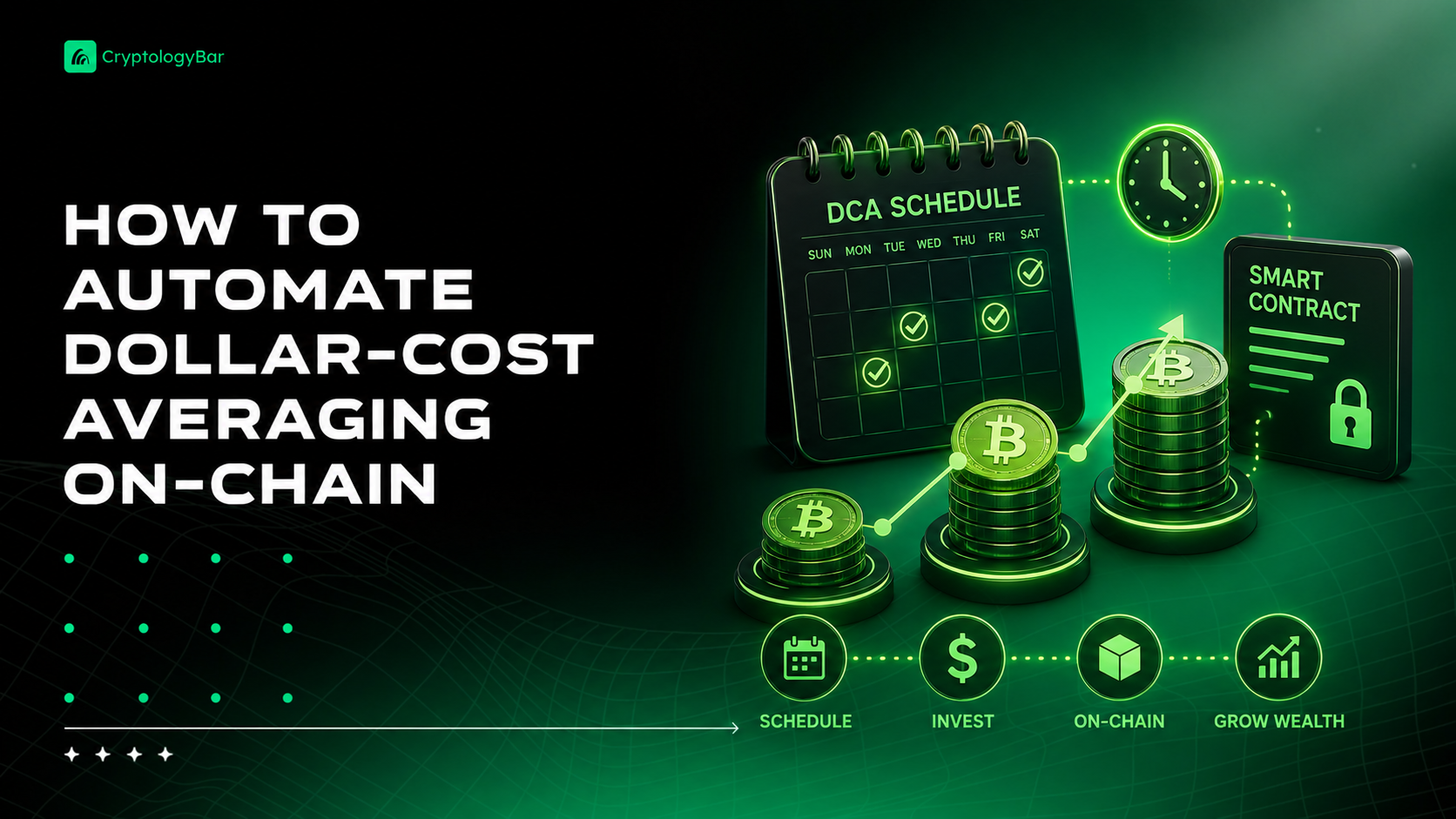
Pick the asset and a sustainable amount. Choose a sensible interval, weekly or monthly for most people. Set up the automation through a tool or contract. Fund it and verify the destination carefully. Then review it every so often. That's the whole flow, and once it's running it genuinely does the boring work you never quite manage to do consistently by hand.
One rule before you walk away
Automation repeats your decisions faithfully, and that includes your mistakes. So verify the token address and the schedule before you activate anything. A wrong setting on a single manual buy is one bad trade you notice and fix. The same wrong setting on an automated schedule runs every single cycle until you happen to catch it, which could be months and many buys later. Set it carefully, confirm the details twice, and then let it do its quiet, unglamorous, genuinely effective job.
That's really the whole appeal. Done right, automated DCA turns investing from a series of nerve‑wracking decisions into a background process you barely think about, which is exactly where a long‑term strategy belongs.
Step-by-step guide
- 1
Pick your asset and amount
Decide which token to accumulate and a fixed amount per interval you can sustain through a downturn without flinching or skipping.
- 2
Choose an interval
Weekly or monthly usually beats daily on-chain, because frequent tiny buys get eaten by gas. Match the interval to your budget and the chain's fees.
- 3
Set up the automation
Use a DeFi tool or DCA contract that executes the recurring buy for you and routes through the best available rate rather than a single fixed pool.
- 4
Fund and verify
Fund the schedule, then double-check the destination token address and network before activating, so an automated mistake doesn't quietly repeat every cycle.
- 5
Review occasionally
Check in monthly to confirm it's executing and your interval still fits your budget. Set and forget, but never set and fully ignore.