

Rajneesh Sachdeva
Crypto Analyst
TL;DR
Any honest Solana price prediction 2026 has to be a range, not a number. SOL's speed, low fees, and busy app ecosystem help. Outage history, token release schedules, and Ethereum layer-2 competition hurt. I lean cautiously optimistic, but I'm not betting the house.
Key takeaways
- Nobody can give you a reliable single-number Solana target for 2026, and anyone who does is guessing.
- SOL's real strengths are speed, cheap fees, and a genuinely active developer and app ecosystem.
- Network outages, token release schedules, and layer-2 competition are the risks that keep me cautious.
- A potential spot ETF and institutional interest could matter a lot, but timing is anyone's guess.
- Treat scenarios as maps of possibility, size positions carefully, and do your own research.
Let me get the awkward part out of the way first. I can't tell you what Solana will be worth in 2026, and neither can the guy on YouTube with the laser eyes and the arrow pointing straight up. Any serious Solana price prediction 2026 is a set of maybes, not a target on a dartboard. So that's what you're getting here. Scenarios, reasoning, and my own hedged read.
I've traded through enough cycles to have opinions. I've also been humbled enough to hold them loosely. Back in the last bull run I watched people build entire life plans around a single price target that a random newsletter printed. Most of those plans aged terribly. The market doesn't owe anyone a round number.
What I can do is walk you through the machinery. What pushes SOL up, what drags it down, and where a reasonable person might expect it to sit under different conditions. If you want certainty, close this tab and go find a fortune teller. If you want a way to think, stick around.
Why one number is basically useless
Here's the thing that bugs me about most price calls. Someone picks a round figure, works backward to justify it, and slaps a year on it. It looks confident. It's mostly theater. SOL sits at the crossroads of crypto sentiment, macro interest rates, regulation, and its own tech story. Change any one of those and the range shifts hard.
So when you see targets that swing from a brutal drop to a five‑times move, that's not analysts being sloppy. That's them being honest about how much genuine uncertainty exists. I'd trust a wide range over a precise number every single time.
Think about how many things had to break right in previous cycles for the big winners to run. Cheap money. Retail mania. A killer narrative. Take any one of those away and the chart looks completely different. SOL is no exception. Its 2026 depends on a stack of conditions that nobody controls and few can predict. That's not pessimism. It's just the actual shape of the problem.
What actually drives Solana
Before I sketch scenarios, let's be clear on the levers that move this thing. These are the pieces I actually weigh.
- Speed and cheap fees. Solana processes transactions fast and cheap, which is a real edge for apps that need high throughput.
- The app ecosystem. DeFi protocols, NFTs, memecoins, and payments all live here. There's been genuine developer activity, not just a ghost town of abandoned projects.
- Payments momentum. Broader payment integrations, like validator support from established money‑transfer players such as MoneyGram, hint at real‑world use beyond speculation.
- Reliability history. Solana has gone down before. Multiple times. That reputation still follows it around.
- Competition. Ethereum's layer‑2 networks keep getting cheaper and faster, chipping at the 'fast and cheap' pitch Solana leans on.
- Institutions and ETFs. Talk of a spot SOL ETF and growing institutional curiosity could open new demand, if and when it lands.
- Token release and vesting. Scheduled token release into circulating supply can add selling pressure that quietly caps rallies.
Notice how half of those are reasons to be hopeful and half are reasons to be careful. That tension is the whole story. Anyone who only shows you one side is selling something. The bulls talk endlessly about throughput and forget the outages. The bears never shut up about outages and pretend the developer activity isn't real. Both are looking at half the board.
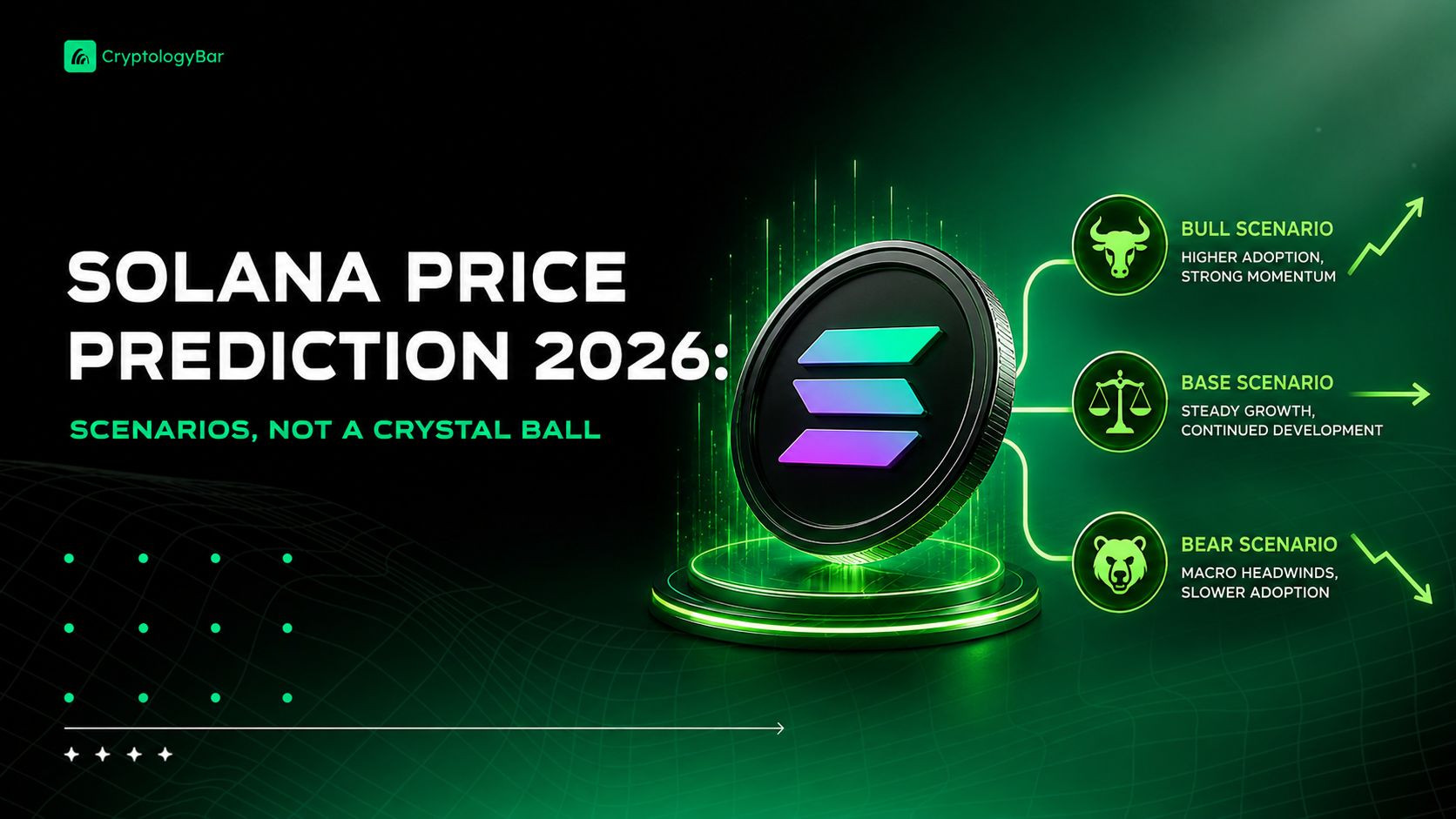
The bear case for 2026
Start with what could go wrong, because that's the part people skip. Picture a rougher macro backdrop. Rates stay sticky, risk appetite cools, and money rotates out of speculative assets. In that world, high‑beta plays like SOL usually get hit harder than the majors.
Now stack on a Solana‑specific scare. Say the network suffers another ugly outage during a busy stretch. Trust takes a knock right when institutions were starting to warm up. Add heavy token release hitting the market and layer‑2s pulling activity toward Ethereum's orbit. Under that combination, I could see SOL giving back a big chunk of its gains and spending 2026 licking its wounds. Not fun, but plausible.
I'm deliberately not putting a floor number on this. What matters is the mechanism. In a real risk‑off flush, speculative tokens don't fall politely. They gap down, liquidity thins out, and the drawdowns get ugly fast. If you've lived through one, you know. If you haven't, plan as though you will. The bear case isn't a prediction of doom. It's the outcome you protect against so a bad quarter doesn't turn into a catastrophe.
The base case for 2026
This is the boring middle, and boring is often correct. Crypto muddles along. No euphoric mania, no total collapse. Solana keeps shipping, the ecosystem keeps growing at a steady clip, and outages stay rare enough that people mostly stop worrying.
In this scenario SOL grinds. Some good months, some ugly ones, a general drift that tracks the broader market with extra volatility on top. Token release gets absorbed because demand roughly keeps pace. It's not a headline‑grabbing outcome. Honestly, it's probably the one I'd put the most weight on if you forced me to pick.
The base case is unsatisfying precisely because it's the most likely. People want fireworks. Markets mostly deliver chop. If 2026 turns out to be a slow accumulation year where the fundamentals quietly improve while the price does very little, that would fit the pattern of plenty of past mid‑cycle stretches. Patience is boring. It also tends to pay.
The bull case for 2026
Now the fun one. Everything lines up. A spot ETF actually gets approved and pulls in fresh institutional money that couldn't easily hold SOL before. The payments story matures into real transaction volume. Reliability stops being a talking point because the network just works.
In that setup, demand outruns the token release schedule, sentiment flips euphoric, and SOL runs hard. Could it multiply from here? In a genuine bull run with an ETF tailwind, sure, that's on the table. But I want to stress the 'if.' Every clause in that paragraph is a condition, not a fact. Bull cases feel inevitable in hindsight and look like fantasy beforehand.
There's also a psychological trap here worth naming. When SOL is ripping, the bull case feels like destiny and the risks feel like FUD. When it's bleeding, the bear case feels like the only sane view. Neither feeling is analysis. Both are just the mood of the moment wearing a suit. The trick is holding the full range in your head even when the crowd is screaming in one direction.
My honest personal take
So where do I actually land? Cautiously optimistic. I like the tech, I like that real people build on it, and I think the payments and ETF narratives have legs. That's the optimistic half.
The cautious half won't go away either. The outage history is a real scar. Layer‑2 competition is getting fiercer, not softer. And token release is the kind of slow, unglamorous pressure that people forget about until it's capping every rally. I'm not selling. I'm also not going all in and pretending I know how this ends.
If I had to compress it into one line: I'd rather be roughly right about a range than precisely wrong about a number. My gut says the base case is most likely, the bull case is a real possibility if the ETF story delivers, and the bear case is the one I actively guard against. That's not a forecast you can screenshot. It's a posture. And posture beats prophecy in a market this moody.
How I'd actually use these scenarios
Scenarios aren't predictions you act on blindly. They're maps. Here's how I put them to work.
- Assign rough odds to each case based on what you're seeing, and update them as news lands.
- Size any position so the bear case is survivable, not catastrophic.
- Watch the real drivers, ETF news, outage reports, token release dates, more than you watch price alone.
- Take profits into strength if the bull case starts playing out. Nobody went broke booking gains.
That framework has kept me sane through more than one cycle. It won't make you rich overnight. It might keep you from blowing up.
One last thing, and I mean it. This is not financial advice. I'm a writer with opinions, not your advisor, and I don't know your situation. Everything above is a way of thinking out loud about probabilities. Do your own research, question every number you see including mine, and never put in money you can't afford to lose. If a 2026 SOL forecast sounds too confident, that's your cue to be skeptical, not sold.