

Rajneesh Sachdeva
Crypto Analyst
TL;DR
Finding low cap crypto gems is less about picking winners and more about eliminating scams before they eat your money. Use a fixed checklist: real product, credible team, an audit, sane tokenomics, real locked liquidity, and a genuine community. Assume most go to zero, and size every position small.
Key takeaways
- A low cap usually means a small market cap, thin liquidity, high volatility, and a much higher chance of failing or being an outright scam.
- Run a fixed due-diligence checklist before you buy, not after: product, team, audit, tokenomics, liquidity, and community.
- Most low caps go to zero. Position sizing is the single thing that keeps a bad pick from wrecking you.
- Honeypots and rugs leave fingerprints, locked liquidity you can verify, sell-tax traps, and huge released team allocations.
- Treat any early-stage project, presale included, as high risk and never put in money you cannot afford to lose.
Ninety‑something out of a hundred are trash. That's the honest starting point for anyone hunting low cap crypto gems, and if a video or thread tells you otherwise, close it. I've been buying small tokens for years and the pattern never changes. Most die. A few limp along. One in a while, something real shows up. The whole game is filtering, not predicting.
So this isn't a shill list. I'm not going to hand you five tickers and tell you to ape in. What I'll give you is the checklist I actually run, plus the reasons each item exists. Steal it, tweak it, argue with it. Just don't skip it.
Quick disclaimer up front. None of this is financial advice, and I have no idea what your situation looks like. Do your own research and only risk money you can genuinely afford to lose.
What a low cap crypto gem actually is
Let's define terms, because people throw "low cap" around loosely. Broadly it means a token with a small market cap. Some folks draw the line under a few hundred million. Others only count micro caps under ten million, or even under one million. There's no rulebook. The point isn't the exact number.
The point is what small size does to everything else. Thin liquidity. Big spreads. Prices that move 40% because one whale sneezed. More room to grow, sure, but way more room to go to zero. That's the trade. You're taking on a pile of risk in exchange for the slim chance of an outsized move.
And here's the part nobody likes hearing. The lower the cap, the higher the odds it's a scam or just dead on arrival. Scammers love small tokens because they're cheap to launch and easy to hype. Keep that framing in your head the whole time.
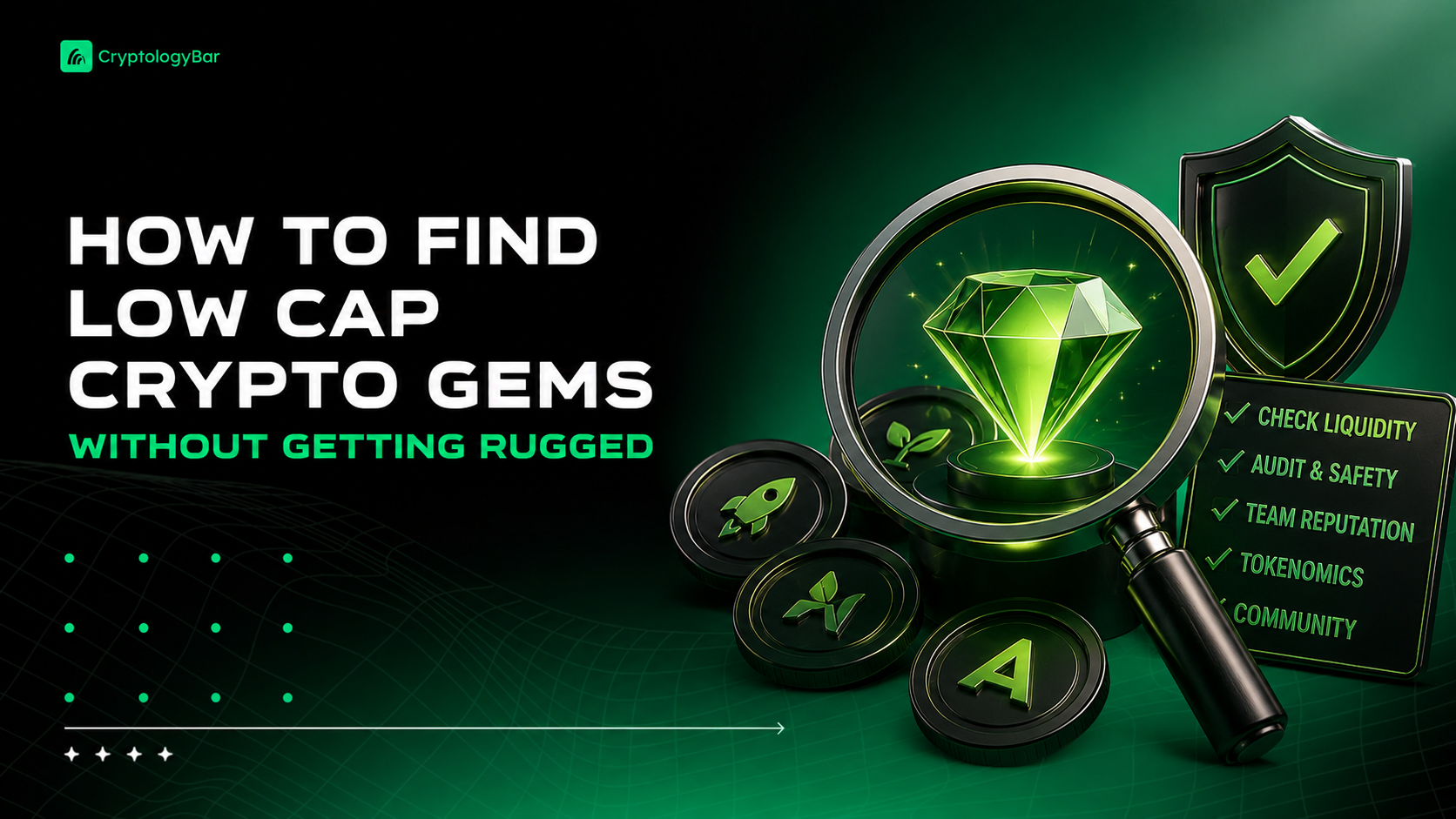
The due‑diligence checklist I run before buying
Before a single dollar goes in, I walk through the same list. If a project fails badly on any one of these, I usually just pass. There are thousands of tokens. I don't need to force this one.
- Is there a real product, or at least a working testnet? Not a whitepaper full of buzzwords. Something I can click.
- Is the team doxxed or at least credible? Anon isn't an automatic no, but it raises the bar on everything else.
- Has the contract been audited by someone recognizable? And can I read the report?
- Do the tokenomics make sense? Supply, allocations, and the vesting schedule all matter.
- Is there real liquidity, and is it locked? Can I actually sell?
- Is the community real people, or a wall of bots posting rocket emojis?
That's the skeleton. Now let me flesh out the parts that trip people up.
Product and real usage beat promises
A roadmap is a wish list. I care about what exists today. Is the app live? Are people using it? Does the GitHub show recent commits, or did it die eight months ago? On‑chain activity is hard to fake at scale, so I look for actual transactions and wallets interacting with the contract, not just holder counts that can be sybil'd in an afternoon.
If the entire pitch is "we're going to disrupt" some huge market and there's nothing shipped, I treat it as a lottery ticket. Sometimes lottery tickets pay. Usually they don't.
Team, audit, and reading the fine print
A doxxed team with a track record is a green flag. It means someone's reputation is on the line. Anon teams can still ship, plenty do, but they've removed the biggest deterrent to just walking off with the money. So I weight the other checks harder when the team hides.
On audits, don't just see the badge and relax. Read the report. Who did it? A firm you've heard of, or a logo nobody can trace? What did they flag, and did the team fix the critical stuff or quietly ignore it? An audit is a snapshot of the code, not a promise about the humans behind it.
Tokenomics and the vesting schedule
This is where a lot of "gems" quietly rot. I want to know the total supply, how much the team and insiders hold, and when their tokens release. A project where insiders control most of the supply with a short vesting cliff is a slow‑motion dump waiting to happen. When those tokens release, they hit the market, and you're the exit liquidity.
Sane setups spread the release over years, keep a reasonable public float, and don't have some hidden mint function letting the team print more whenever they feel like it. Check the release schedule before you assume the low price is a bargain. It might just be a token that's about to get flooded with new supply.
Liquidity, rugs, and honeypots
Thin liquidity is the low cap tax. It means you can get in, but getting out at a decent price during a dump is another story. First thing I check is whether the liquidity pool is locked, and for how long. Liquidity that isn't locked is a rug that hasn't happened yet.
Honeypots are the nastier cousin. The contract lets you buy but blocks or heavily taxes selling. There are free contract scanners that flag suspicious sell taxes and transfer restrictions, and I run one every time on a new token. Not perfect, but they catch the lazy scams. Also watch for a tiny number of wallets holding most of the supply. If three addresses can nuke the price, they eventually will.
One more filter while we're here, the community. Real communities argue. They ask annoying questions, they criticize the team, they post memes that aren't all about price. Fake ones are a firehose of identical hype and "wen moon." I lurk in the Telegram or Discord for a few days before deciding anything. If every critical question gets deleted and the mods only pump, that's my answer.
An example that clears the basic checks
Let me show what passing the checklist looks like in practice, not as a price call, just as an illustration. Blazpay's presale is live right now, and it happens to clear the basic filters that most low caps flunk. It's VC‑backed, which puts credible names on the line. It's been audited by QuillAudits, so there's a report you can actually read. It's raised somewhere around three million so far, and it's building a full DeFi plus AI stack, a bridge, a swap, DCA tooling, rather than a token with no product behind it. That combination, real backers, a real audit, and something being built, is exactly the profile the checklist is meant to surface. To be clear, it's still an early‑stage play and early‑stage means high risk, presale or not. Clearing the checklist lowers the odds of a scam. It doesn't promise the thing goes up.
Position sizing is the whole game
Here's the truth that makes all of this survivable. You will pick wrong. Repeatedly. Even with a tight checklist, most low caps you touch will underperform or die, because that's the base rate of the category. So the answer isn't to be smarter. It's to be smaller.
Size each position so that a total loss is annoying, not devastating. Spread across several picks instead of betting the farm on your favorite. If one going to zero would wreck your month, you're in too heavy. I'd rather hold ten small bets and have eight fail than one big bet that takes me out.
Do the boring work. Run the list. Skip the ones that fail. Keep your sizes small. That's not exciting, but it's the only version of low cap hunting that doesn't end with a screenshot of a wallet full of dead tokens. And again, none of this is advice. It's just how I try not to blow up.