

Akshita Jhalani
Crypto Analyst
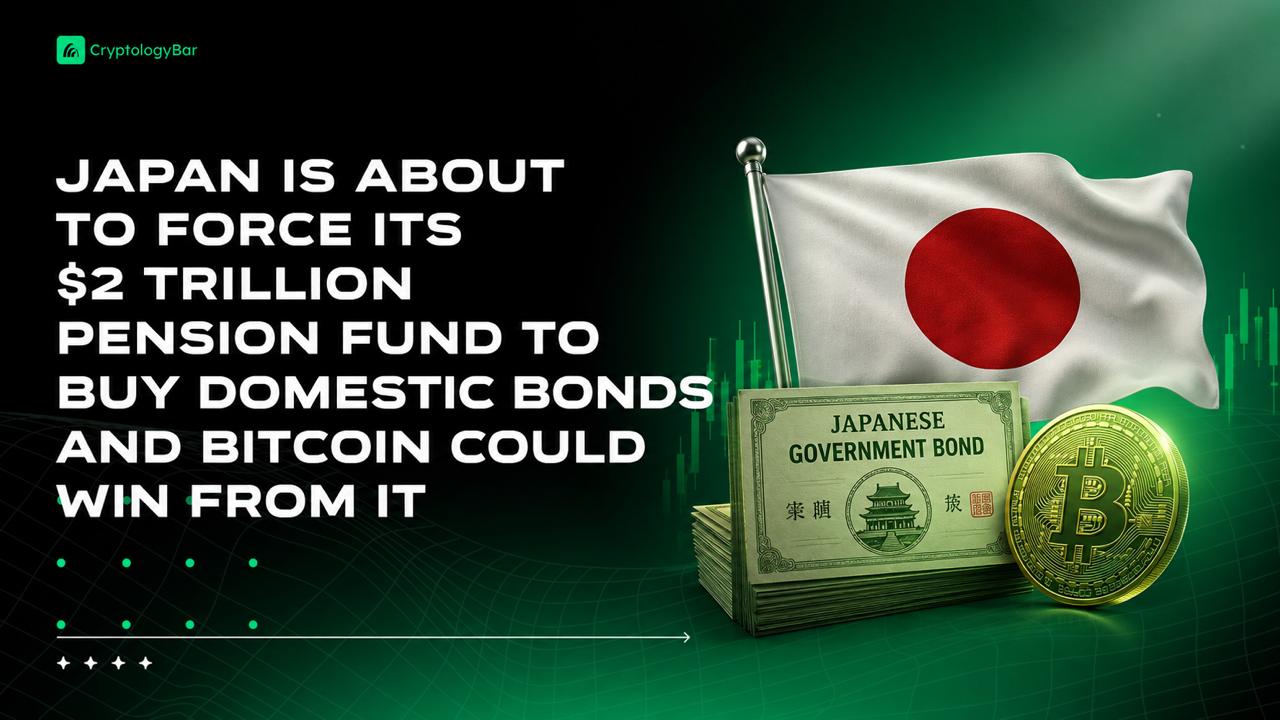
Something was said in Tokyo this Friday morning that I think most crypto traders are underweighting. Japanese Finance Minister Satsuki Katayama confirmed the government is actively steering the Government Pension Investment Fund, the largest pension fund on Earth, managing $2 trillion in assets, to substantially increase its domestic investment. More Japanese government bonds. More local stocks. Fewer foreign assets.
The announcement landed while Bitcoin was trading above $64,000 and looking technically constructive for the first time in weeks. The timing is interesting, and the long‑term implications are worth understanding clearly.
What Financial Repression Actually Means
Let me explain the mechanism the Japanese government is deploying, because it has a name that financial historians recognize immediately: financial repression.
Japan's public debt‑to‑GDP ratio exceeds 200%, one of the highest in the developed world. Its 10‑year government bond yields just hit three‑decade highs. The yen has lost 60% of its value since 2021 despite repeated rate hikes. The government is now doing what indebted nations throughout history have done when those pressures become acute, it's directing domestic savings institutions to buy its own bonds, keeping yields below inflation and allowing the debt burden to erode over time.
This approach was used extensively by Western nations after World War II. It worked, but it came at a cost. Investors holding government bonds earned returns that persistently lagged actual inflation. In real terms, their savings shrank while the government's debt burden quietly deflated away.
Why This Creates Demand for Bitcoin and Gold
Here's the direct connection to digital assets. When government bonds consistently fail to preserve purchasing power, when the institution designed to protect retirement savings is being directed to hold assets that will likely lose real value, individual investors and pension beneficiaries start looking for alternatives that can't be inflated away.
Bitcoin has a fixed supply of 21 million coins. Gold has a naturally constrained supply. Neither can be printed by a central bank decision or redirected by a Finance Minister. In environments where government‑directed financial repression is the dominant policy tool, these properties have historically driven significant demand toward hard assets.
The housing price comparison made the argument visually clear earlier this week. Priced in dollars, American homes have gained significantly since 2020. Priced in Bitcoin, that same home costs about 90% fewer coins. The fiat price went up. The real cost, measured against a hard asset, collapsed.
The Near‑Term Risk That Comes With This
I want to be honest about the complication in this story, because it's real. The GPIF currently holds $931 billion in foreign assets, including $232 billion in the U.S. Treasuries. If even a fraction of that gets redirected toward Japanese domestic bonds, the effect on U.S. Treasury yields and global risk appetite could be significant.
A meaningful rotation of GPIF capital away from U.S. assets creates market jitters. When institutional money moves at that scale, risk aversion follows, and that near‑term risk‑off environment would likely weigh on Bitcoin before any long‑term hard‑asset demand thesis plays out.
What I'm Taking Away Heading Into the Weekend
The long‑term case is clear to me. If Japan has crossed the line into formal financial repression, the incentive to hold scarce assets outside the government‑directed system rises significantly, not just for Japanese investors but as a model other indebted nations may follow.
The near‑term picture requires more caution. Bitcoin is trading above $64,000, the MACD has flipped bullish, and the chart looks better than it has in months. But $65,400 and $67,300 are the real tests ahead. Until those levels fall, the long‑term thesis about Japan's pension policy boosting Bitcoin demand remains a forward‑looking story, not today's trade.