

Ethan Caldwell
Crypto Analyst
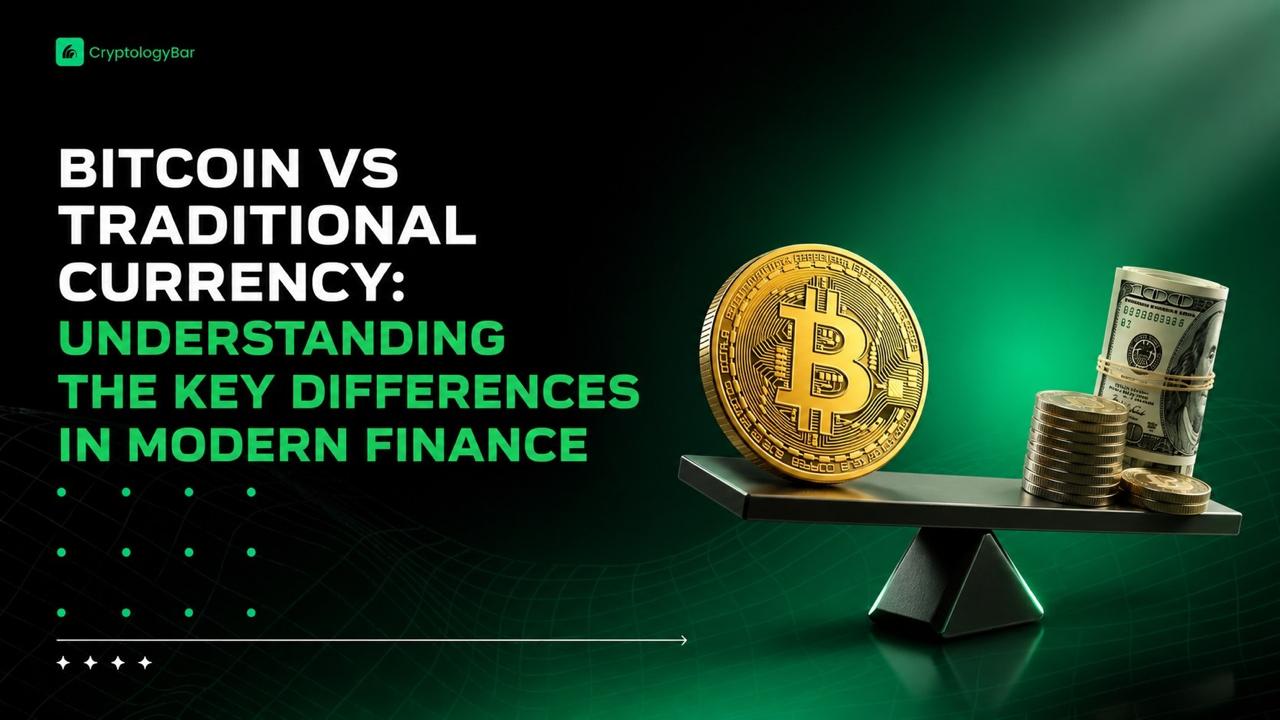
The global financial system is undergoing a major transformation, driven by the rise of digital currencies. At the center of this shift is Bitcoin, a revolutionary form of money that challenges the long‑standing dominance of traditional currencies like the rupee, dollar, and euro. The main job of both is to make transactions easier, but they work, are controlled, and are used in very different ways. Understanding these differences is essential for anyone looking to navigate the future of finance.
What is Traditional Currency?
Traditional currency, also known as fiat money, refers to government‑issued money such as the Indian Rupee or US Dollar. These currencies are regulated and controlled by central banks and governments, which manage supply, interest rates, and monetary policies to stabilize the economy.
Fiat currencies derive their value from trust in the issuing authority rather than any physical backing like gold. Governments ensure their acceptance by declaring them legal tender, meaning they must be accepted for payment within a country. This centralized system has been the backbone of global finance for centuries, providing stability, regulation, and widespread acceptance.
What is Bitcoin?
Bitcoin, introduced by Satoshi Nakamoto, represents a completely different approach to money. It is a decentralized digital currency that operates without the need for banks or governments. Instead, it relies on a global network of computers to verify and record transactions.
Bitcoin exists purely in digital form and is powered by Blockchain technology. This allows transactions to be transparent, secure, and immutable. Unlike traditional currencies, Bitcoin is not printed or controlled by any authority, making it resistant to manipulation and inflation caused by policy decisions.
Centralization vs Decentralization
One of the most fundamental differences between Bitcoin and traditional currency lies in control. Traditional currencies are centralized, meaning they are managed by central banks. These institutions can influence the economy by printing money, adjusting interest rates, or implementing financial policies.
In contrast, Bitcoin operates on a decentralized network. No single entity has control over the system. Transactions are verified by a distributed network of participants, ensuring that power is not concentrated in one place. This decentralization reduces the risk of corruption, censorship, or mismanagement, but it also removes the safety nets provided by centralized institutions.
Supply and Inflation
Traditional currencies have an unlimited supply. Governments can print more money when needed, especially during economic crises. While this flexibility helps manage economies, it can also lead to inflation, reducing the purchasing power of money over time.
Bitcoin, on the other hand, has a fixed supply of 21 million coins. This scarcity is built into its code and cannot be changed. As a result, Bitcoin is often seen as a hedge against inflation. Its limited supply creates a sense of digital scarcity, which can drive value as demand increases.
Transaction Process and Speed
Transactions with traditional currency often involve intermediaries such as banks or payment processors. These transactions can take time, especially for international transfers, and may include fees for processing and currency conversion.
Bitcoin transactions eliminate intermediaries by allowing peer‑to‑peer transfers. While this can make transactions faster and more efficient, the speed can vary depending on network congestion. In some cases, Bitcoin transactions may take longer during periods of high demand, but they generally offer greater flexibility for cross‑border payments.
Security and Transparency
Traditional banking systems rely on centralized databases, which can be vulnerable to hacking or internal fraud. While banks invest heavily in security, breaches can still occur, and users must trust institutions to protect their funds.
Bitcoin offers a different model. Transactions are recorded on a public blockchain, making them transparent and nearly impossible to alter. The use of cryptography ensures that funds are secure, provided users protect their private keys. However, this also means that individuals are fully responsible for their own security, with no option to recover funds if access is lost.
Privacy and Anonymity
Traditional financial systems require users to provide personal information for transactions, such as identity verification and banking details. This ensures compliance with regulations but limits privacy.
Bitcoin offers a higher level of privacy by using wallet addresses instead of personal identities. While transactions are publicly visible, they are not directly linked to individuals. However, this does not make Bitcoin completely anonymous, as transaction patterns can sometimes be traced.
Accessibility and Financial Inclusion
One of the biggest advantages of Bitcoin is its accessibility. Anyone with an internet connection can use Bitcoin, regardless of their location or access to banking services. This makes it a powerful tool for financial inclusion, especially in regions where traditional banking infrastructure is limited.
Traditional currencies, while widely accepted, often require access to banks or financial institutions. This can exclude millions of people worldwide who do not have access to these services.
Volatility and Stability
Traditional currencies are generally stable because they are regulated by governments and supported by economic policies. While they may fluctuate, these changes are usually gradual and predictable.
Bitcoin is known for its volatility. Its price can rise or fall dramatically within short periods due to market demand, speculation, and external factors. While this volatility creates opportunities for high returns, it also introduces significant risk.
Regulation and Legal Status
Traditional currencies operate within well‑established legal frameworks. Governments regulate their use, ensuring consumer protection and financial stability.
Bitcoin exists in a more uncertain regulatory environment. Different countries have different rules regarding its use, taxation, and legality. While some nations embrace it, others impose restrictions or bans. This evolving regulatory landscape adds complexity to Bitcoin adoption.
The Future of Money
The debate between Bitcoin and traditional currency is not about one replacing the other entirely but rather about how they will coexist in the future. Traditional currencies offer stability and deep integration into the global economy, while Bitcoin introduces innovation, decentralization, and new opportunities for financial independence.
As technology continues to evolve, it is likely that both systems will play important roles. Governments are even exploring digital versions of traditional currencies, blending elements of both worlds.
Final Thoughts
Bitcoin and regular money are based on two different ideas about money: one is based on decentralization and innovation, while the other is based on centralized control and stability. Each has its own pros and cons, and it's important to know these differences in order to make smart financial choices.
As the financial landscape continues to evolve, the ability to adapt and understand both systems will become increasingly important. Whether you view Bitcoin as the future of money or simply an alternative asset, its impact on the global economy is undeniable.