

Rajneesh Sachdeva
Crypto Analyst
TL;DR
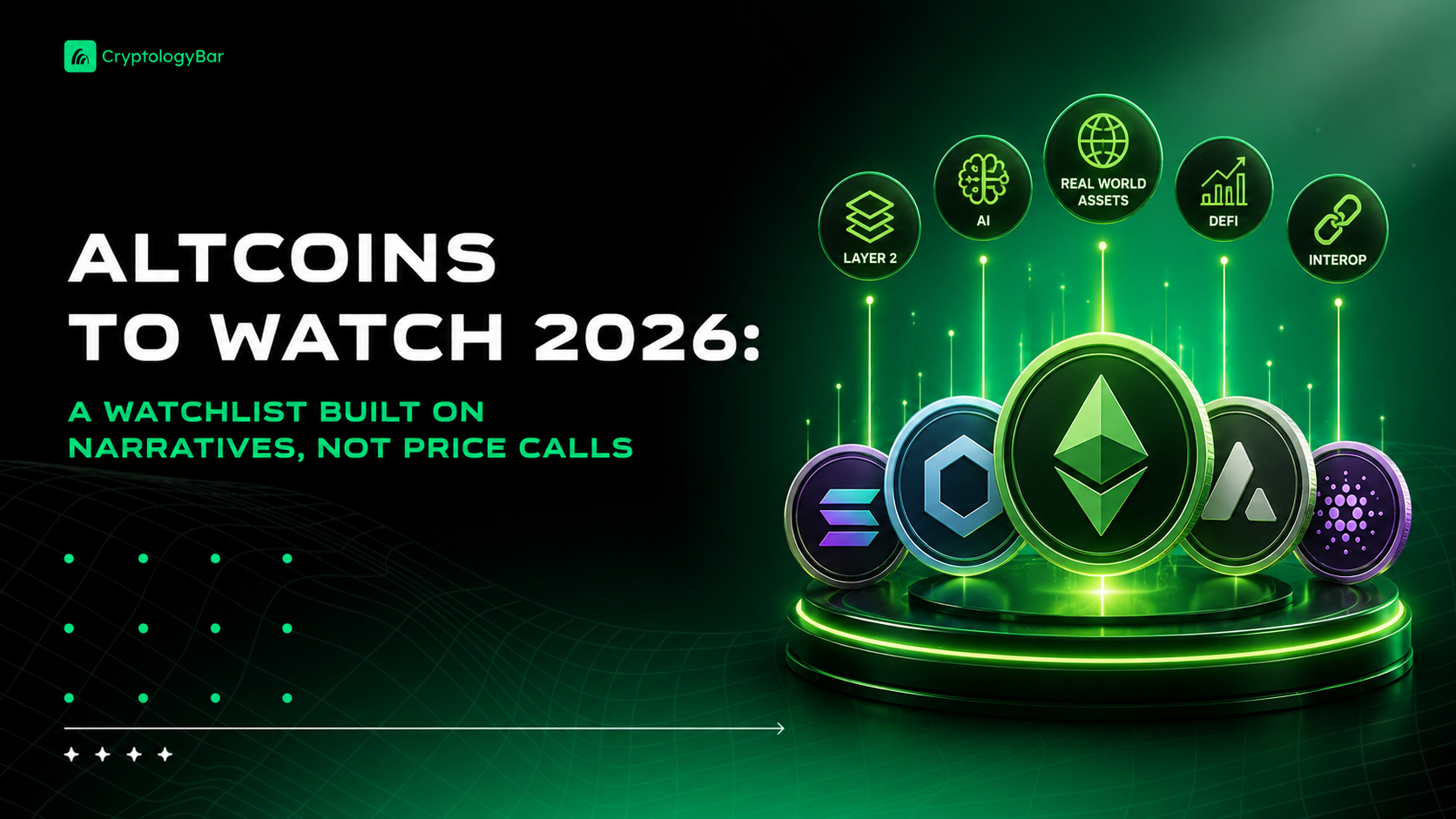
This is a narrative-based watchlist of altcoins to watch in 2026, grouped by theme instead of price calls. We cover layer-1s, Ethereum layer-2s, real-world assets, DeFi blue chips, AI-plus-crypto, and the meme-coin wildcard, with the risks for each flagged clearly. Watching means research, not buying.
Key takeaways
- Themes move altcoin markets more than individual coins, so watching narratives beats chasing single tickers.
- Most altcoins underperform Bitcoin over a full cycle, and a large share simply die off.
- Layer-1s, layer-2s, real-world assets, DeFi, AI-crypto, and meme coins are the live narratives to study going into 2026.
- Meme coins are the highest-risk slice on this list and run almost entirely on attention, not fundamentals.
- A watchlist is a research list, not a buy list, and none of this is financial advice.
Let me start with the boring part, because it matters most. A watchlist is not a buy list. When I say these are altcoins to watch in 2026, I mean watch as in study, follow, read about, and understand. Not click buy. Those are two completely different activities, and confusing them is how a lot of people lose money.
Okay. With that out of the way.
I don't pick altcoins by ticker anymore. I pick by theme. Crypto money rotates through narratives, and when a story catches fire, the coins attached to it tend to move as a group. So the smart thing isn't hunting for the one magic coin. It's understanding which narratives have legs and which projects actually do the work behind them. That's the whole frame for this list.
And before I name anything, the uncomfortable truth: most altcoins underperform Bitcoin over a full cycle, and a huge chunk of them just die. Quietly. The team stops shipping, the volume dries up, the chart flatlines near zero. That's the base rate. Keep it in your head the entire time you read this.
Layer‑1s and the scaling fight
Ethereum isn't the only base‑layer blockchain, and the competition to be a fast, cheap place to build apps is still very much alive. Solana is the obvious example here. It runs a high‑throughput design that's good at handling lots of cheap transactions, which is why so much trading and consumer activity ended up there. Other layer‑1s pitch their own tradeoffs around speed, fees, and decentralization.
Why watch this narrative? Because if a chain becomes the default home for a new wave of apps, the demand for its native token tends to follow. That's the bet.
What could go wrong? Plenty. Some of these chains have had ugly outages where the network just stopped. Others promise huge performance and then can't keep it up under real load. And being technically impressive doesn't guarantee anyone actually builds on you. A ghost chain with great specs is still a ghost chain.
Ethereum layer‑2s
Instead of replacing Ethereum, layer‑2s try to scale it. They bundle transactions off the main chain, process them cheaply, then settle back to Ethereum for security. Arbitrum and Optimism are the two big rollups people point to. Base, built by Coinbase, is another one that pulled in a lot of users fast because it had a giant exchange funneling people in.
The reason this is a narrative worth following: if Ethereum stays the settlement layer everyone trusts, the rollups sitting on top of it could capture a big share of day‑to‑day activity. They're where a lot of the actual usage is happening.
The risks are real, though. There are a lot of layer‑2s now, and they're fighting over the same users. Some of them barely differ. The token doesn't always capture the value the network creates, which is a polite way of saying you can be right about the tech and still hold a token that goes nowhere. And there are technical concerns around how decentralized some of these rollups truly are today.
Real‑world assets and tokenization
This one's quieter than meme coins but it's a narrative serious people keep coming back to. The idea is putting real things, like treasury bills, bonds, credit, even property, onto a blockchain as tokens. Tokenized treasuries have already grown into a real category, with traditional finance names experimenting in the space.
Why it's worth watching: if big institutions actually move assets on‑chain at scale, that's a genuinely large pool of value, and the protocols that handle it could matter a lot. It's one of the few crypto stories where the upside isn't purely speculative.
What could go wrong? Regulation, mostly. Tokenizing real financial assets drags you straight into securities law and compliance, and that can move slowly or block things entirely. There's also the awkward fact that a token representing a real asset is only as trustworthy as whoever's holding the actual asset off‑chain. The blockchain doesn't fix counterparty risk by itself.
DeFi blue chips
DeFi means decentralized finance, the on‑chain versions of lending, borrowing, and trading without a bank or broker in the middle. The so‑called blue chips are the protocols that have survived multiple cycles and still process real volume. Think of the big decentralized exchanges and lending platforms that have been around since the last bull run and didn't blow up.
Why watch them? Survival means something in crypto. Protocols that kept working through crashes, hacks elsewhere, and bear markets have proven a kind of durability that most projects never get to show. They have real users and real fees, not just promises.
The catch: DeFi is a constant target for hackers, and a single exploit can drain a protocol overnight. Regulation hangs over the whole sector too. And token holders don't always get a clean slice of the fees the protocol earns. Being a blue chip lowers some risk. It doesn't remove it.
AI plus crypto
AI is the loudest tech story on the planet right now, so of course crypto wants in. The pitch covers a few things: decentralized networks for computing power, marketplaces for AI models and data, and tokens meant to coordinate AI agents that transact on‑chain. Some of these projects are doing real engineering. A lot are just stapling the letters A and I onto a token.
Why it's on the watchlist: if any of these actually become infrastructure that AI systems rely on, that's a big deal. The overlap of two huge trends draws attention, capital, and builders.
Why I'm cautious: this is the category where hype most outruns substance. The word AI in a project's name is doing heavy lifting, and a lot of these will turn out to be narrative with nothing underneath. Separating the teams shipping real tools from the ones riding the buzzword takes actual digging.
The meme‑coin wildcard
I'll be blunt about this one. Meme coins are high risk and mostly vibes. There's usually no product, no revenue, no real fundamentals. The whole thing runs on attention, community energy, and luck. When a meme coin pumps, it's because enough people decided to care at the same time. When it dumps, it's because they stopped.
So why even mention it? Because meme coins genuinely move markets during manic phases, and pretending they don't exist would be dishonest. They're part of the crypto reality, especially on the faster, cheaper chains where launching one is trivial.
But here's the warning, in plain words: most meme coins go to zero. Many are outright scams, with insiders dumping on everyone who showed up late. If you ever touch this corner, treat it like money you've already lost. That's not a figure of speech.
How to actually use a watchlist
Watching is the work. Here's roughly how I approach a name once it's on the list.
- Figure out what the project actually does, in one plain sentence, with no jargon.
- Check whether anyone's using it or it's all roadmap and promises.
- Look at who's building it and whether they keep shipping.
- Understand if and how the token captures any real value.
- Write down what would make you wrong, then watch for it.
Notice none of those steps are buy. That's the point. By the time you understand a project well enough to even consider a position, you'll also understand most of the reasons not to take one.
A few rules I keep coming back to
Some things I try to remember, especially when a narrative gets loud and my fear of missing out starts talking.
- Altcoins are far riskier than Bitcoin. Smaller, thinner, more fragile.
- Themes can flip cold fast. Yesterday's hot narrative is tomorrow's dead chat.
- Liquidity matters. Getting out is harder than getting in when things turn.
- If you can't explain why a token has value, that's your answer.
And the honest summary of this whole list: these narratives are worth understanding because they're shaping where attention and money flow in 2026. That doesn't make any single coin a good buy. It makes them worth learning about.
One last thing, and I mean it. None of this is financial advice. I'm not telling you to buy anything here, and I'm not predicting prices or returns, because nobody can. Do your own research, only risk what you can afford to lose entirely, and treat every name on this list as a starting point for study, not a signal to act.