

Akshita Jhalani
Crypto Analyst
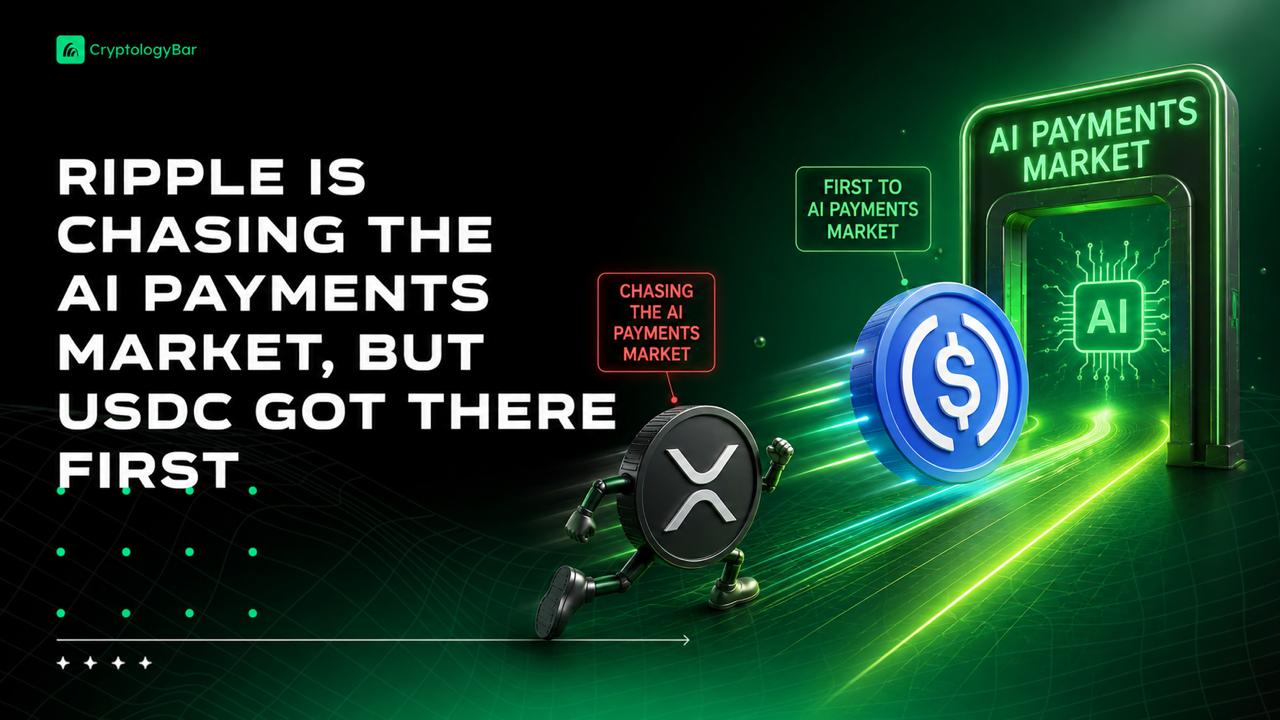
There's a quiet race happening in crypto that most people aren't watching closely enough. AI agents, software that operates autonomously, buys API access, pays for compute, and settles invoices without a human approving each transaction, need payment rails. Ripple wants those rails to run on XRP and RLUSD. The market, right now, mostly disagrees.
What Ripple Just Launched
Ripple introduced the XRPL AI Starter Kit this week, a bundle of developer tools designed to help builders create AI agents that send payments directly on the XRP Ledger. The kit includes XRPL documentation accessible through an MCP server, wallet creation tools, balance checks, and support for something called x402 payments using both XRP and RLUSD, Ripple's dollar‑backed stablecoin.
The pitch is clean and sensible on paper. AI agents need to pay for things fast and cheaply, model inference, API calls, service access, without triggering manual approvals. Ripple says XRPL settles in three to five seconds, charges predictable fees, and comes with native payment functions, escrow, multisig, and a built‑in decentralised exchange baked directly into the protocol. No smart contract execution risk. No external swap contracts. Just the ledger doing what it was built to do.
What x402 Actually Is
The protocol underpinning all of this is x402, originally created by Coinbase and now managed by the Linux Foundation's x402 Foundation. It works by reviving HTTP's old 402 "Payment Required" status code, essentially letting machines pay for online resources inside normal web requests. An AI agent asks for a paid service, gets a payment request back, makes an on‑chain payment, and resubmits with proof. It turns payments into something that feels more like an API call than a financial transaction.
The concept is genuinely clever. The adoption data, though, tells a different story about who's winning.
The Market Is Running on USDC, Not XRP
A public x402 dashboard from Web3 Trackers shows over 120 million cumulative transactions, more than $41 million in USDC volume settled, and activity spread across 14 blockchains. Base alone accounts for about 70 million transactions and $21.5 million in volume. Solana handles roughly 45 million transactions and $16.4 million. USDC dominates both.
A Chainalysis report from early June noted that x402 activity on Base surged from near zero in mid‑2025 to over 100 million cumulative transactions by Q1 2026, though a significant portion of that spike was driven by PING, a pay‑to‑mint meme coin experiment that turned x402 payments into a speculative loop rather than genuine utility.
The point stands: developers building agent payment systems have largely gravitated toward Base and Solana with USDC. Ripple is entering a market where the early defaults are already forming.
Why XRPL's Case Still Has Merit
Speed and cost do matter when an AI agent is making thousands of tiny payments in quick succession. XRPL's native DEX also opens up an interesting possibility, an agent could send RLUSD while the receiver takes XRP, or the reverse, without needing an external swap contract. For institutions wary of smart contract risk, that is a genuinely useful feature.
What's Still Missing
Ripple has not announced any named customers, disclosed real transaction volumes, or pointed to a production deployment using XRP or RLUSD for agent payments at scale. The toolkit is live. The usage is not yet visible.
That gap between infrastructure and adoption is the entire story here. Building the rails is one thing. Getting developers to route their agents across them instead of defaulting to USDC on Base is something else entirely.