

Sophia Bennett
Crypto Analyst
For years, crypto traders wanting exposure to US stocks had two options: open a traditional brokerage account, or trade synthetic proxies on DeFi platforms using unreliable third‑party price feeds. Ostium just made both of those options look outdated.
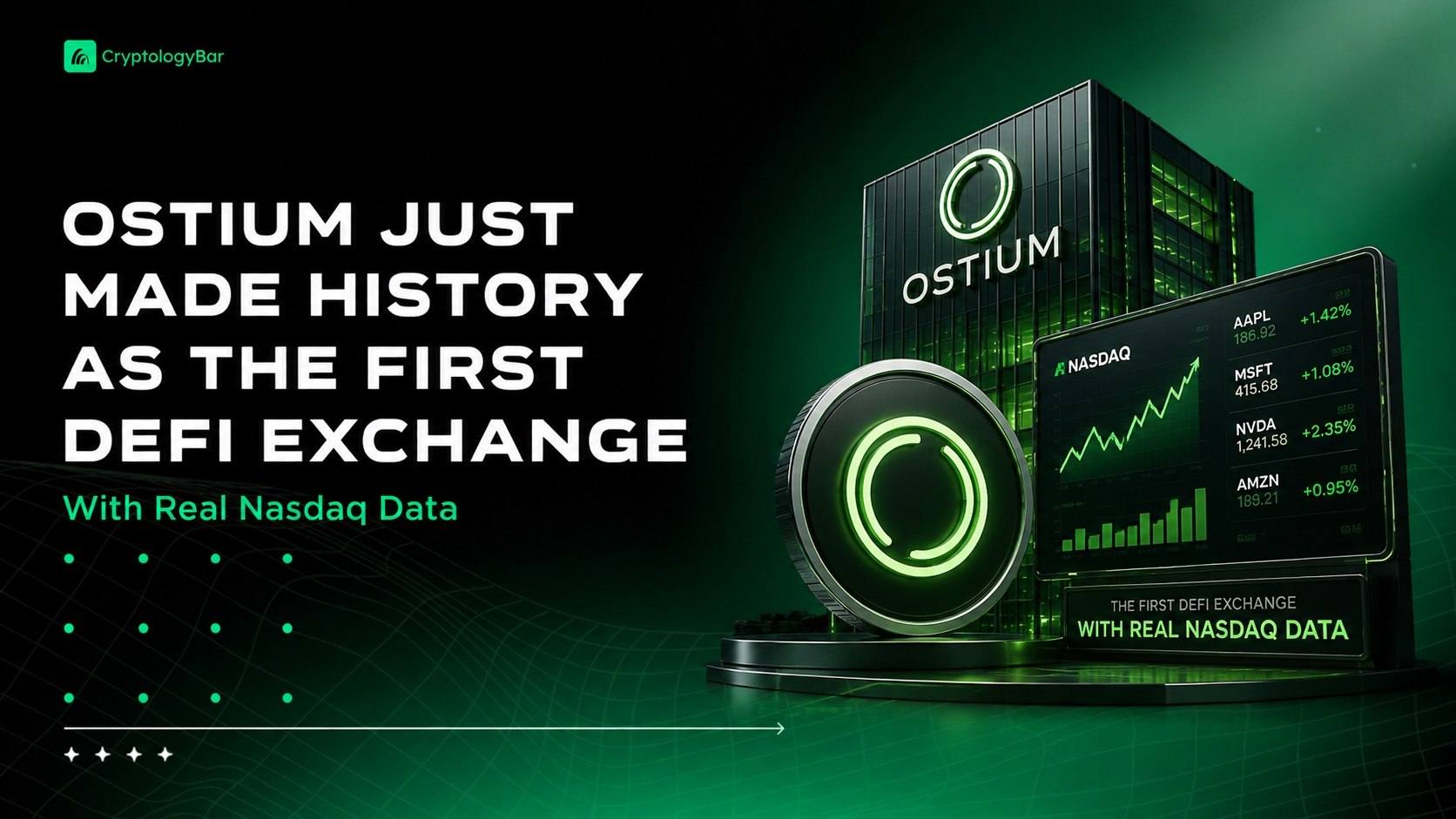
Onchain perpetuals exchange Ostium announced it has partnered with Nasdaq to use the exchange operator's equities data, making Ostium the first onchain trading venue to offer equity perpetual products powered by official Nasdaq data.
This is not just a product launch. It is a structural shift in what DeFi can credibly offer global traders.
The Problem Ostium Is Solving
Getting access to US equities has always been messy for global retail traders.
"Access to US markets has historically been fragmented, permissioned, broker‑gated, and limited by geography," Ostium said. "Traders worldwide can now gain exposure to US equities on Ostium with the benefits of blockchain rails: transparency, instant settlement, and self custody."
A trader in Nigeria, India, or Southeast Asia who wants to go long Apple or short Tesla has historically needed a broker account, currency conversion, custody with a third party, and trading hours that may not match their time zone. Ostium removes every single one of those barriers, and replaces them with a USDC deposit and a wallet tap.
How the Platform Actually Works
Ostium is a self‑custodial leveraged trading platform built on Arbitrum, an Ethereum Layer 2 blockchain. Traders can go long or short on stocks, currencies, indices, and commodities directly from their wallets, without any broker, without frozen funds, and with all fees, volumes, and liquidity visible onchain.
Ostium provides synthetic exposure through perpetual contracts. Trading Apple or S&P perps gives you exposure to their price movements, but not the underlying asset. This structure makes it possible to trade price movements of equities fully onchain without tokenisation or custody of the physical stock.
The platform offers up to 200x leverage across assets, with a small opening fee of 3 to 5 basis points depending on the asset, plus a rollover fee for open positions. Settlement uses USDC on Arbitrum.
The Numbers Behind Ostium's Growth
This partnership did not arrive for a platform that is just getting started.
Ostium has processed over $50 billion in cumulative volume across more than 26,000 traders. That is real usage, real capital, and a real user base that has been building since the platform launched.
Ostium was founded by Harvard alums Kaledora Kiernan‑Linn and Marco Antonio Ribeiro. The company has raised $27.8 million to date, including a $20 million Series A co‑led by General Catalyst and Jump Crypto.
Jump Crypto co‑leading the round is notable. Jump is one of the biggest crypto derivatives liquidity providers and hedging partners, and it implies that Ostium is institution‑grade as a platform providing infrastructure.
Nasdaq Is Actively Building Into DeFi
It is not only the DeFi space that is undergoing a strategic change under Nasdaq, it's the company itself.
In March 2026, Nasdaq collaborated with Payward to develop infrastructure that links the tokenized equity markets with decentralized blockchain networks.
The partnership underscores both the rapid growth of equity perpetuals in onchain markets and Nasdaq's broader strategy to support tokenized equity trading infrastructure.
The world's second‑largest stock exchange is not dabbling in DeFi. It is building towards it systematically, and Ostium is the latest, most direct expression of that direction.
What the Market Looks Like Right Now
The timing is significant. The broader equity perpetual market on DeFi has already exploded.
Trading volume of onchain traditional assets including stocks, commodities, foreign exchange, and bonds surged 162% from $11.8 billion in December 2025 to $31 billion in January 2026 alone.
Perp DEX volume jumped from $81.74 billion in January 2024 to $739.48 billion by January 2026, an eight‑fold increase in two years, as traders have grown increasingly comfortable with onchain derivatives platforms.
Ostium is entering that market with one thing no competitor has: official, institutional‑grade Nasdaq pricing. For traders who have been frustrated by the gap between DeFi promise and TradFi‑quality execution, this closes the gap in the most credible way possible.