

Rajneesh Sachdeva
Crypto Analyst
TL;DR
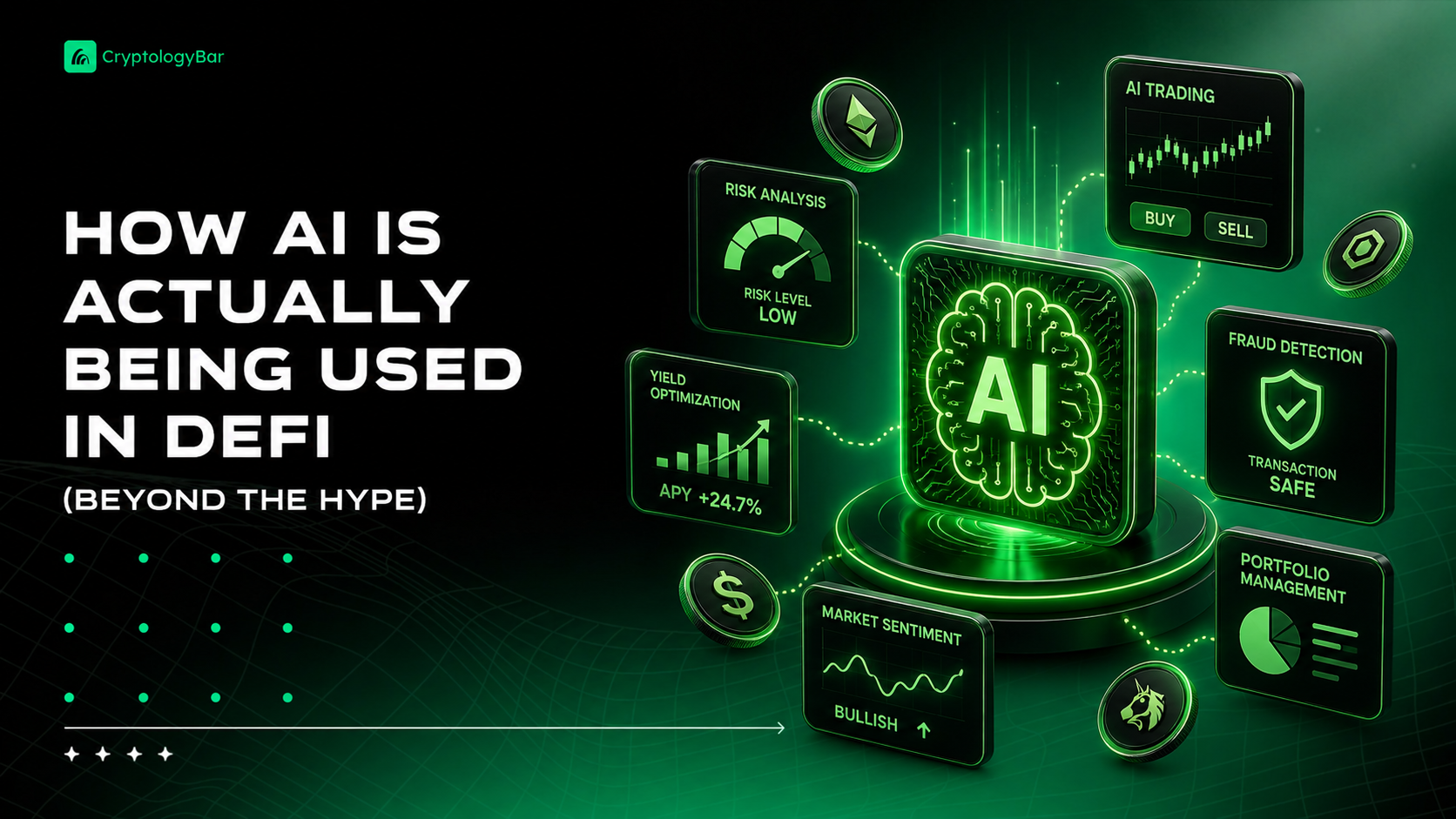
In DeFi today, AI mostly does practical, unglamorous work: finding the best trade route, scoring token and contract risk, and automating recurring actions like DCA. It's useful for optimization, not magic, and anything promising AI that predicts price for guaranteed profit is a red flag.
Key takeaways
- AI's real DeFi uses are route optimization, risk scoring, and automation.
- Most 'AI' in token marketing is a label, not a working feature.
- AI that 'predicts price for guaranteed profit' is bait, not a feature.
- AI optimizes decisions; it never removes the need to verify what you sign.
Let me cut straight through it. 'AI‑powered' is stamped on nearly every DeFi landing page now, and most of the time it means precisely nothing. But underneath all that noise, there genuinely are a few places where AI earns its spot. They're just far less exciting than the marketing implies, which, frankly, is usually how you can tell which uses are real and which are decoration.
So here's the honest split: where AI actually does useful work in DeFi, and where it's a sticker on the box.
Where it genuinely does work
Routing is the big, real one. When you swap or bridge, there are dozens of possible paths through different pools and venues, and the prices shift constantly as people trade. Crunching all of them in real time to find the cheapest route is exactly the kind of fast, repetitive optimization machines are good at and humans simply aren't. You would never compare forty routes by hand in the few seconds before a price moves. Software does it in a blink, and that's a genuine, measurable benefit rather than a buzzword.
Risk scoring is another legitimate use. Models can scan a token's contract, its liquidity, and its holder patterns to flag the obvious traps faster than you'd spot them by eye. It's not perfect, and it shouldn't be treated as gospel, but as a quick first filter that says 'this one has ten red flags, slow down,' it's genuinely useful. And then there's automation, the quiet workhorse: recurring buys, rebalancing, conditional actions that run on a schedule so your strategy doesn't quietly depend on you remembering to act.
Where it's mostly a label
The clearest tell is anything promising AI that predicts price and prints you money. That's not a feature, it's bait, and it preys on exactly the people most hopeful about AI. If a model could reliably call the market, nobody would package it up and sell it to you for the price of a token. They'd quietly use it themselves and never say a word. So treat 'AI trading bot, guaranteed returns' as the red flag it always is, no matter how slick the dashboard looks.
The broader pattern holds up well: real AI features in DeFi tend to do unglamorous optimization work, while fake ones promise excitement, prediction, certainty, effortless riches. When the pitch sounds thrilling, be more suspicious, not less.
How to tell the difference in practice
A simple test: ask what the AI is actually optimizing. If the answer is something concrete and verifiable, 'it finds the cheapest route across these venues,' or 'it flags contracts with these risk patterns,' that's plausibly real, and you can usually check its work. If the answer is vague and grand, 'it uses advanced AI to maximize your gains,' that's marketing dressed as a feature. Concrete and boring tends to be real. Sweeping and exciting tends to be a story.
Where I've found it genuinely useful
This split is roughly why I've leaned on Blazpay. The AI there does the boring‑but‑valuable stuff, routing each swap, bridge, or DCA buy through the best available rate across providers, rather than promising to predict where the market goes next. It's an aggregator with the route‑finding automated, which is AI quietly doing a real, checkable job instead of selling a fantasy. If you want to see that kind of practical routing in action, it's at defi.blazpay.com.
The line to remember
Here's the one principle to hold onto. AI in DeFi optimizes your decisions. It does not make them safe for you. A model can find you the cheapest route and still cheerfully execute a transaction you didn't actually understand, into a token that turns out to be a trap. So let it save you fees and time and tedious comparison, genuinely useful things, but keep reading what you sign. The machine handles the math. You still own the judgment, and in DeFi, judgment is the part that keeps you solvent.