

Sophia Bennett
Crypto Analyst
AI agents can now do something they have never been able to do before: spend money on their own.
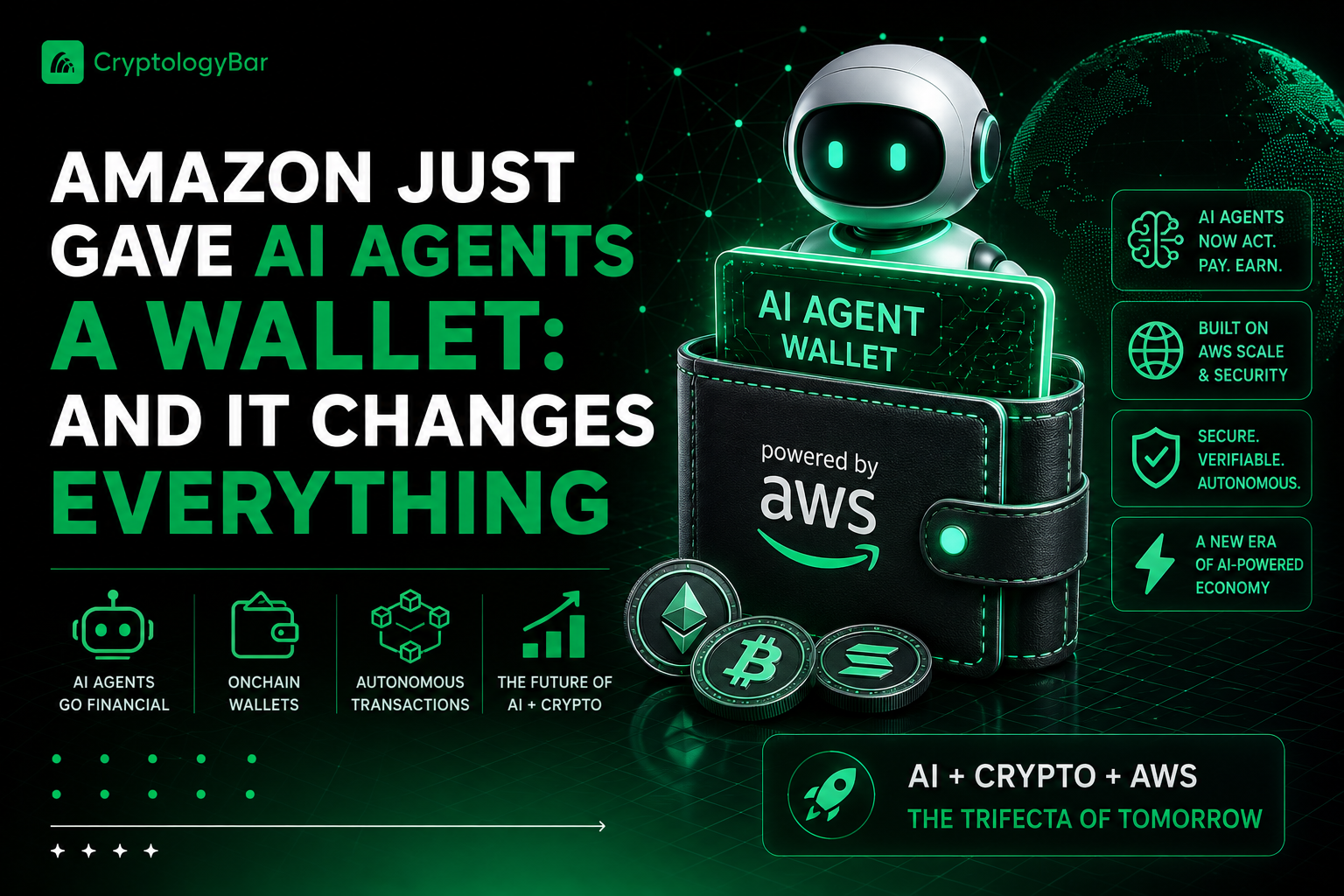
Amazon Web Services has partnered with Coinbase and Stripe to enable AI agents to execute transactions using stablecoins, marking one of the clearest signs yet that Big Tech is embracing blockchain‑based payment rails for the emerging agentic economy.
The product is called Amazon Bedrock AgentCore Payments, and it is live in preview right now.
What AgentCore Payments Actually Does
The idea is straightforward, even if the technology behind it is not.
AgentCore Payments enables AI agents to instantly access and pay for what they use, web content, APIs, MCP servers, and other agents, with Coinbase and Stripe providing the wallet infrastructure and payment rails that power the first set of capabilities.
Developers can integrate payments through a single API call. The system handles wallet authentication, transaction signing, and settlement automatically. Agents do not control private keys, which reduces security risks.
This removes what has been a significant wall in AI development. Until now, agents could think and act, but they could not pay. That limitation is gone.
The x402 Protocol Is the Engine Under the Hood
X402 is named after the previously unused HTTP 402 "Payment Required" status code. It allows websites, APIs, and AI‑powered agents to request and receive instant micropayments via blockchain‑based and traditional payment rails.
Amazon Bedrock AgentCore Payments has integrated Coinbase's x402 discovery layer and wallet infrastructure, helping AWS developers deploy agents that can discover, make micropayments, and use services entirely on their own. These AI agents will be able to pay in USDC on Solana and Base.
Coinbase describes this as the first time a major cloud platform has built crypto micropayments directly into its agent infrastructure.
Stripe Joins as the Fiat Gateway
Crypto is not the only option. Stripe brings the traditional finance side of the equation.
AgentCore is integrating Stripe's wallet infrastructure, powered by Privy, as a payment connection in preview, giving developers direct access to Stripe's payment infrastructure from day one. Together, AWS and Stripe are working toward a shared path to fiat payment support as the platform expands beyond micropayments.
Developers using AgentCore Payments will be able to choose between a Coinbase or a Stripe wallet and then fund those wallets using stablecoins or fiat.
Built for Enterprises, Not Just Developers
This is not a product built for solo developers experimenting in their spare time. The guardrails built into AgentCore Payments make clear that enterprises are the real target.
The product gives developers time‑bound spending limits, compliance controls through Coinbase's CDP Facilitator, and logs, metrics, and dashboards across the full payment lifecycle. These controls are intended to help enterprises move agentic commerce beyond prototypes by addressing legal, compliance, and audit requirements before agents are allowed to spend money in production.
Before an agent can transact, the end user must explicitly authorise it to access and use their wallet. At runtime, spending limits are enforced per session, keeping the agent within a defined budget for each execution. The agent never has open‑ended access to funds.
The Bigger Picture: A Machine Economy Is Being Built
Developers from companies like Cox Automotive, Thomson Reuters, and PGA TOUR already use AgentCore to build agents that reason, plan, and act across complex workflows. With today's announcement, those agents can also transact.
The x402 Foundation, which governs the open standard behind this infrastructure, includes Cloudflare and Stripe as founding members, with support from Amazon Web Services, American Express, Ant International, Visa, and Microsoft.
The message from that list of names is loud and clear. The machine economy is not a future concept anymore. It is being built right now, and Amazon, Coinbase, and Stripe just laid down a major piece of the foundation.